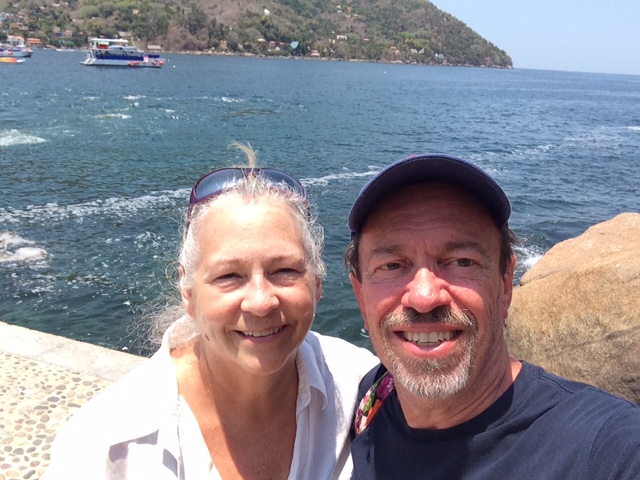
Hasta Luego, Puerto Vallarta!

IMG_1679
This little guy is called a social flycatcher. He and his relatives have been visiting our pool for the past two months. Pretty bird with an obnoxious call!

Leslie and I leave tomorrow morning for the next stop in this vagabond lifestyle — Mérida, capital of the state of Yucatan (JOO-kah-tan).

This is Hasta Luego (“see you later”) rather than Adios! because we may very well be back. We like this city. San Miguel de Allende is still at the top of the list, and we still have other places to see. But PV is definitely in the running. We need to spend more time in the centro, the downtown area that’s also called the Romantic Zone.

We can already see a scenario that would have us in San Miguel for the summer and Puerto Vallarta for the winter. Best of both worlds.

The good things about this little slice of heaven include:

  • Lots of places where you can contribute to the local economy, including U.S.-based big box stores like Costco (where I got new contact lenses this week) and Home Depot, but also many small locally owned places. Leslie came out of one marina-area shop with lots of great-looking lightweight clothing at good prices.
  • A good Anglican church, Christ Church by the Sea.
  • The locals are warm and friendly. They don’t mind us gringos being here because we help create jobs. And that’s a good thing.
  • Many expats here, and our friends Mike and Sara Wise make sure there are several events a month to get people together. We met David and Michelle Webster at a coffee hour several weeks ago, and later had dinner with them. Fun couple, whom we hope to see again.
  • Lots of great restaurants, and not just Mexican places. Italian, Chinese, Brazilian, seafood, you name it.
  • A number of interesting places outside PV to explore — such as Magical Cities like San Sebastian.

The downsides are:

  • It’s big. Maybe too big. Lots of places and lots of people. Puerto Vallarta is several different areas with vastly different vibes.
  • Walkability is good in the marina but poor if you want to go to other areas, like downtown or the shopping centers — almost essential to have a car here.
  • Access to farmers markets and local mercados is limited.
  • Many expats here (once again, that’s a positive and a negative), and they seem a little bit cliquish, although they would say that’s not true.
  • Not many cultural opportunities here, at least not that we have found. However, we did miss an opportunity to be at a chamber music concert early last month, and last night we attended the second evening of the 11th Festal Vallarta Azteca del Folclor Internacional.
IMG_1574
Mexican folk dances, complete with colorful costumes, were a big hit with the crowd of mostly locals at the international folkloric dance festival that opened Wednesday evening. The beach is just behind that stage, so we had a nice view of the sunset, too.
Sunset3-1
We will miss this view. 

Next post from Mérida. We’ve heard the daytime high temperatures hover near 100° F. It’s a colonial city, like San Miguel, but a 30-minute bus ride gets you to a great Gulf of Mexico beach! More to come…

Do you know what Mexican Turkey is?

A quick update while we are sitting by the pool, enjoying nice breezes and recovering from a couple of journeys with Vallarta Adventures (see “Whale of a Tale”), the tour company Leslie and I really like.

Before I tell you about those trips, another plug for US Global Mail, the Houston company that handles our mail for us, and for shipping service DHL. This week the mail included a new credit card to replace one that expires in May, and a check. Most of our mail gets thrown away or scanned to store on my laptop, but I needed that credit card, as well as the check. DHL got it here in just two days — a day sooner than promised — and at a discount thanks to US Global Mail. DHL makes it easy to track the shipment and their website is user-friendly.

The check is from International Living magazine, the first of many I hope to receive from them and similar publications. IL recently used an article I wrote about our vagabond lifestyle, so I am now a travel writer!

And our daughter Stephanie was here over Easter weekend to celebrate her birthday (April 14), along with her friend Kelly. The two of them often bunk together on group travel excursions, so they appreciated having their own rooms in our three-bedroom condo!  We celebrated Steph’s birthday at Puerto Vallarta’s top-rated restaurant, Tintoque, right down the street from our condo. The next night, we took them to Victor’s in the marina. A more casual, fun place known for free tequila shots. Stephanie was aghast when she arrived Friday night to find that her mother’s tan was better than hers. She and Kelly spent much of weekend trying to fix that.

Victor's-0828
Victor welcomed us to his restaurant and gifted Stephanie (left) and Kelly with a bottle of his uncle’s famous tequila. Steph says it will stay at her place, but Kelly expects a shot whenever she visits. Happy Birthday, Stephanie!


It was great to see her again. If we decide on Mexico rather than a European country as our retirement home, it will be easier for Steph to come see us from her home in San Diego, and vice versa.

This week we went on excursions to Yelapa (pronounced gel-AH-pah), a small coastal village accessible only by boat, and to the silver mining town of San Sebastian.

At Yelapa, we saw a neat waterfall, walked through the town, relaxed on the beach and tasted some incredible raicilla, which is made — like tequila — from the agave plant, and is distilled only here in the state of Jalisco. Very smooth.

IMG_0839
This waterfall greets you as you complete a climb up Yelapa’s hill. Some in our group took a dip in the pool.

Vallarta Adventures staff, especially the amazing tour director Pablo, kept us entertained all the way there and back on the boat – about 90 minutes each way. Just before lunch, Leslie and I got a chance to paddle a sea kayak around a pretty little cove. First time for both of us! Lunch was a make-your-own sandwich buffet. Leslie pointed to one of the choices and asked a crewman, “What is this?” With a straight face he replied, “Mexican turkey. Brown pelican.” Then he winked. It was just regular turkey, of course. I wonder how many times a week he uses that one!

On the cruise back to PV, Pablo and the staff performed — OK, lip-synced — some old rock ‘n’ roll standards as “The Mexican Rolling Stones,” complete with makeup and props. Having an open bar helped us enjoy it a bit more, but those guys put on a great show. They were very funny!

IMG_0860
Got a selfie in as we prepared to board the boat back to Puerto Vallarta. Yes, that’s my Cubs cap — sorry the “C” doesn’t show. I wore it one day on the beach at the PV Marriott and met a guy who said he was once a Cubs bat boy. He knew Ernie Banks! Had fun talking with him.

Yesterday’s excursion was by van, over narrow, winding roads through the Sierra Madre Mountains to the silver mining village of San Sebastian del Oeste. Tour guide Gabriel kept up a running commentary on a variety of topics, including bits of Mexican history. San Sebastian was once home to some 30,000 people while 90 area silver mines were operational. Now the mines are gone and there are only about 600 residents. The town, with its narrow cobblestone streets and whitewashed homes, hasn’t changed much since the 1910 Mexican Revolution drove many people away, primarily the upper classes. It is one of more than 100 places the government has designated as a Magical City, or Pueblos Mágicos.

We visited Hacienda Jalisco, where silver ore was refined in the 18th and 19th centuries.

IMG_1691
Hacienda Jalisco. At least one website claims this may have been one place where Elizabeth Taylor and Richard Burton hooked up during filming of “Night of the Iguana.” Our guide didn’t mention it, though.

Once owned by the great film director John Huston, some of it has been restored. You can see the smelters where ore was baked in one of the steps to create pure silver. After a terrific lunch at the Secret Hotel (“secret” because you can only stay or eat there if you know the owner), we saw a family-owned organic coffee roasting operation. The family matriarch, “Mary,” had 21 children. We bought some of the coffee from a gentleman known as “veinte” (Spanish for 20) because he’s the 20th child, and he looked to be close to 70 years old. The video below is the roasting part of the process. Yes, it smelled fantastic!

Error
This video doesn’t exist

The formal walking tour ended at the home of the Encarnación family, which has lived in this house since the 1700s. Part of it is now a museum. Then we spent some time in the beautiful church just off the plaza, and saw a silversmith’s shop. Both our guide and the silversmith admired Leslie’s silver necklace. Her father brought that necklace home from a business trip to Mexico almost 40 years ago. Gabriel said the craftsman who made that style of jewelry passed away a number of years ago, and they don’t see his work very often. Gabriel was impressed.

Last stop, fortunately, was a visit to Hacienda Don Lalin, a local tequila distillery. After a brief introduction by our host, Lalo (who grows his own agave plants), we tasted some very fine tequila, mezcal and raicilla, as well as amaretto- and coffee-flavored tequilas. Once again, we contributed to the local economy and hit the road back to Puerto Vallarta.

IMG_1741
Lalo is a third-generation tequila distiller, and his products are very tasty. The labels say “Don Lalin,” who was Lalo’s grandfather. 

One more week here in this bustling Mexican beach town. Then Leslie and I move on to Mérida, capital of the state of Yucatan. It’s 10- to 20-degrees hotter there, but we’ve heard great things from a number of people about that colonial city.

Hasta luego!

Lake Chapala: Best climate in the world?

Leslie and I took one of our side trips this week to check out a place we’ve heard has “the best climate in the world.” It’s the Lake Chapala (chah-PAH-lah) area, about an hour south of Guadalajara. We were only there for a day and a half, but we’re going back because this area is now on our list.

We visited the town of Ajijic (ah-HEE-hick) to renew an acquaintance from over 20 years ago. Leslie and I knew Marlene Syverson when we all attended University United Methodist Church in San Antonio, Texas.


IMG_1499
Our old San Antonio friend Marlene at the Wednesday morning mercado in Ajijic. 

Marlene left Texas in 1994, but kept in touch through the years with Joan Ahrens, who was singles pastor at UUMC at the time (and a key force in getting Leslie and me together). Leslie read one of Joan’s Facebook posts recently, in which she said she had visited Marlene in Lake Chapala. Surprise!

So we spent five hours on a plush, first-class double-decker bus through the Sierra Madre Mountains to Guadalajara, Mexico’s second-largest city. We had primo seats at the front of the upper deck, with great views of lush valleys, extinct volcanos and huge fields of agave plants (main ingredient in tequila). A 45-minute taxi ride from the new Guadalajara bus station got us to Ajijic, a quaint little town similar in many ways to San Miguel de Allende.

IMG_1488
Make you hungry?  The climate means local farmers can grow crops year-round.

Marlene took us to the Wednesday mercado in Ajijic (some of the best produce we’ve seen, plus meats and fish!) and showed us several towns and neighborhoods, including Ajijic, Chapala, San Juan Cosala and San Antonio, where she has lived (yes, a little bit ironic) for a little over a year. Some are stunning, high-dollar homes with sweeping vistas, and some are quaint little Mexican houses with lots of character. We caught up with Marlene and learned more about her life in Mexico.

So what did we find? Lake Chapala itself is beautiful. It’s the largest lake in Mexico and is natural, not man-made. Small towns like Ajijic ring the lake, with gringos living mostly in Ajijic, Chapala and San Juan Cosala. We expected to find beaches and lots of boats, but there are no beaches and only the gringos paddle around in kayaks, Marlene being one of them.

IMG_1466
Lake Chapala. It’s really much bigger than it looks here. Marlene says there is a volcano on the other side of that prominent mountain. Some days, she can see smoke rising.

Best climate in the world? Well, International Living says the region has “one of the best.” This is due partly to “lake effect,” with Lake Chapala acting as a moderating force on highs and lows. And there are mountains north and south of the lake, helping ameliorate storms. Temperatures are in the 70s fairly consistently throughout the year, with the annual average between 75° and 78° F. Add in low humidity and a brief rainy season, and it’s hard to beat. That’s similar to what we found in San Miguel, but in SMA it can get pretty chilly at night — down into the low 40s — and the daytime temps can vary with the seasons. Also, Ajijic is at 5,000 feet altitude, a little over 1,000 feet lower than SMA. Closer to Denver-type altitude. The rainy season begins in mid-June, but most of the rain comes at night and is not constant. Long-time resident expats say it might rain every three days or so.

The cost of living here appears to be quite low.  Marlene left the mercado with a huge bag of vegetables that cost her the equivalent of $5 US. Leslie was lusting after the beautiful heads of red- and green-leaf lettuce, but we had no way to get it home!

I checked a couple of rental agencies in Ajijic and found some two-bedroom, two-bath homes and apartments available for under $1,000 US a month on a long-term rental. And some of them have views of the lake!

IMG_1468
Ajijic’s malecon. I can see myself jogging on this esplanade every morning!

If you don’t mind being outside the centro you can rent a nice home for $500 US per month or less. Houses for sale run the gamut, some are on the market now for $100,000 US or less. Marlene says property taxes can be as much as $100 US per year. That’s right – per year. Propane gas appears to be fairly costly but electricity is not, especially since you don’t need air conditioning.

There’s more, but I will revisit the Lake Chapala area in-depth in a later post. Much later. Leslie and I are thinking we will spend a couple of months in Ajijic next year, probably mid-January at least through the end of February, maybe longer. We want to be in Ajijic for the Festival de Febrero, a classical music festival formerly known as Northern Lights Music Festival.  We got to know two of the festival’s biggest backers, Canadian expats Tony and Roseann — their son produces the festival every year.

So it was a great visit with Marlene and an enlightening tour of the Lake Chapala area. We will be back.

But we still have one month here in Puerto Vallarta, and lots more to see and do. Next time, I hope to focus on the cost of living here.

Hasta luego!


And now for something completely different!

We have arrived in Puerto Vallarta, Mexico, and the difference between this city and San Miguel de Allende – where we lived for the past six weeks – is amazing. It’s bigger. More than 300,000 in the metropolitan area, with lots more traffic. It’s a beach town at sea level, with high temps and moderate-to-high humidities. Even more Americans and Canadians.

Leslie and I were able to rent a modern three-bedroom condo in Marina Vallarta that backs up to a golf course. We have a small pool in a huge outdoor space with lots of tables and chairs. We’ve already had one visitor (see photo below)! And we’re seeing (and hearing) a number of birds I can’t easily identify. A sparrow-sized cutie with a reddish-pink head and chest, a larger bird with yellow on its chest and a streak from its eye backward along its head, and a woodpecker. And what I think may have been a goldfinch – not sure.

iguana-1440
Saw this small iguana joining us on our first day in the sun! I didn’t have a snack to offer, so he left!

Hal, our Canadian landlord for the next two months, has a local administrator for his property. Rosanna picked us up at the airport on Wednesday and gave us some pointers on the marina area.

“It’s very safe here,” she said. “You can walk all around the area any time of day or night and you’ll be safe. Just one thing that you must never do: Never, ever, walk across the golf course at night.”

I was having a difficult time figuring out why. Would we be attacked by banditos lurking the links after hours? Bopped on the head by golf balls from blind golfers playing in the dark to avoid crowds? No and no.

“Crocodiles,” she said. “In the dark, you might step on one, and they don’t like it when you step on them.”

Right. What’s now a huge marina with lots of boats and tons of shops and restaurants, not to mention a plethora of condos, was once a swamp. There are still crocs here. It’s their habitat. So the danger is from wildlife, not from a wild life.

IMG_1442
In English: Danger. Crocodiles. No Swimming.

Rosanna has been very helpful. On Friday, she took us on a tour of Vallarta, showing us a bit of the old city and pointing out areas we will need to explore in depth over the next two months. She also took us to a local mercado for fresh fruits and vegetables, as well as seafood and meat.

There’s also a Wal-Mart and a Costco, in addition to Mexican grocery stores very much like the one we patronized in San Miguel. More on cost of living next time, but at first glance it appears prices are slightly higher here than in San Miguel.

We attended our first Vallarta ex-pats dinner on our second day in town. A number of them live here in the marina area, including Mike and Sara, the group leaders. There’s a social event almost every week.

We also attended Sunday morning services at Iglesia Cristo del Mar, or Christ Church by the Sea. But…it’s not really by the sea, more like on a really busy street close to the airport! I dressed as I would for any summer Sunday at Grace United Methodist Church in Naperville. Boy, was I overdressed! Shorts and t-shirts are not out of place here. It’s another outpost of the Anglican Church in Mexico, like the one we attended in SMA, and we enjoyed the service in what is essentially a big open-air palapa. Nice people. We will be back.

We’re really excited that John and Anne Mixen, friends from Grace UMC, are right here in Vallarta this week for a well-deserved vacation. We’re meeting them this evening to watch the sunset and enjoy dinner and conversation.

I’ll leave you with the view from our patio toward the golf course. We planned to do things today but we’re still on the patio because of a comment I made during lunch, “This is just about perfect, and you don’t often get perfect.” Maybe more often here in Vallarta. We’ll let you know.

Hasta luego!

IMG_1443
Looks great, doesn’t it? Behind these lounge chairs is a round table with four chairs where we’ve been having lunch almost every day. The only down side to this space is watching the golfers on what appears to be the 18th fairway. I don’t play golf, but know a lousy swing when I see one. Have to keep myself from yelling, “follow through, dude!” or “Hey, your stance is too wide!”


San Miguel is Number One. Just like the Chicago Cubs!

Back when I was working, my good friend and colleague John Peterson and I always made it through depressing pro football and basketball seasons in Chicago by saying, “How long until spring training?” (OK, the Blackhawks are winners, but neither of us understands hockey!) Well, spring training has begun anew. And this year, the Cubs are defending World Series Champions!!!

The Cubs are Number One, and apparently so is San Miguel de Allende.  No, we haven’t reached a final decision, but if we had to choose today our retirement home would be SMA. Will we be here  when the Cubs win the 2017 World Series? Can’t answer that one yet. We’ve still got several places to see.

We’re both a little surprised that we like Mexico so much. I always felt that our primary focus for a retirement home would be Europe, probably Spain, and it might still be that. So why is San Miguel the leading contender right now?

img_1358
The iconic Parroquia, the beautiful parish church that dominates SMA’s “skyline.” As the sun shifts during the day, the colors change. So it looks different in the afternoon than in the morning.

The climate here is just great — warm and dry. It’s been as low as 69º F. and as high as 81º F. for daily highs, with humidities usually below 50 percent. And there’s very little rain this time of year. In the six weeks we’ve lived here it has rained twice, both times at night and only briefly. Local expats tell us that during the “rainy season” it either rains at night or for an hour or two in the afternoon. All-day rain or thunderstorms — very rare. Yes, it gets cool at night, but it rarely gets into the 40s until the wee hours, like 4 or 5 a.m. We’re snug in bed then. And in the dead of summer, daytime highs are slightly higher but nothing excessive because we’re at 6,200 feet altitude. Those who have been here awhile say to expect highs in the mid to upper 80s and lows around 60º F. We can handle that!

San Miguel, as noted in earlier posts, has an extensive arts scene with concerts, plays, operas, ballets, films, lectures and tons of art galleries. Many restaurants have live music on the weekends. One of our friends at St. Paul’s Anglican Church — and a long-time expat — put it best when he said, “I try to limit cultural events to one per day.” St. Paul’s is yet another reason to choose SMA. Good group of people there, and we like the rector, a retired Episcopal bishop from the States. There are also a number of charities here with many opportunities to volunteer. So we could stay pretty busy if we lived here. Or not.

Another person from St. Paul’s told us she has a good friend in the real estate business and can help us find a long-term rental. Lots of people come down here for six to nine months and rent their homes when they’re not here.

img_1371
This is a boveda ceiling in one of SMA’s many churches. Lots of buildings have this unique brick work ceiling. It’s even in some homes. Go here to see a two-minute video showing how they do it.

Then there’s the food. We love the fresh local produce we get at the mercados, and the meat we get at the carnicieras. But SMA also has a ton of great restaurants, from hole-in-the-wall chicken joints with locals lined up out the door, to high-end places with top-flight international chefs and stunning views. One could never go hungry in San Miguel.

International Living magazine touts Mexico as 2017’s top retirement country. Last year, I think, it was Panama. There are a lot of positives about San Miguel, and about Mexico in general:

  • Mexico boasts one of the strongest economies in the western hemisphere right now.
  • It’s close to the U.S., so we can get back relatively quickly and without great expense in case there’s a family emergency.
  • Health care here is excellent, as we noted with Leslie’s visit to the podiatrist. And we have friends who always see a dentist while they’re here to get crowns and root canals — just as good as in Chicago at one-third the cost, they say.
  • There are many creature comforts in Mexico, like theaters, shopping centers, good cell phone and internet coverage. In the cities, even the small ones, there’s nothing third-world about this country.
  • The cost of living in general is low, especially if you pay in pesos. Friday morning we met another couple at a popular breakfast spot and had a lovely meal for a little over $500 pesos — about $25 USD. For FOUR people.
  • There are a lot of other expats here, mostly from the U.S. and Canada, but some from the U.K. and other countries.

OK, what are the downsides:

  • There are a lot of other expats here, mostly from the U.S. and Canada, but some from the U.K. and other countries. No, that’s not a mistake. Too many gringos is a problem. It tends to drive prices, especially home prices, higher.
  •  We will need to learn more Spanish. We’re getting by OK with limited knowledge, but if we’re going to live here we need better command. And we would have to do that if we chose Spain, too.
  • We’ll have to adjust to time here, and how things are done. This is Mexico, things don’t always go as smoothly and perfectly as in the States. Even though they don’t do siesta here in San Miguel, mañana is a way of life. You have to be patient sometimes.

    img_1365
    Traffic can be a problem in SMA, but drivers are much more courteous here than in the U.S.

So we have a lot to think about. But now it’s on to the beach town of Puerto Vallarta on Mexico’s Pacific coast. We have already connected with the expat community there, and we’ve signed up for a dinner on Thursday night after we arrive Wednesday afternoon. This group has lots of social events like dinners and happy hours — every week!

The condo we’ve rented from a Canadian guy named Hal is very different from all the places we’ve lived in on this trip. It’s a modern townhouse in a gated community called Marina Vallarta. It’s on a fairly busy street, but it backs up to a golf course. We have three bedrooms and a huge outdoor area with a plunge pool. It’s nowhere close to the historic centro. We will be able to walk to the marina area and to the beach, but we’re unsure about how to access the local produce in farmers markets, as were able to do in Spain and to a lesser extent in Malta. Hal says taxis and buses are plentiful and cheap. We’ll be in Vallarta for two months — all of March and April.

Next post from Puerto Vallarta!

44552eb3-10e9-4c99-b0f2-1fa8eec84026
Go Cubbies!


Sunny San Miguel

Leslie and I have arrived in San Miguel de Allende, about three hours north of Mexico City. This UNESCO World Heritage Site is about 6,200 feet above sea level and has a population of about 140,000 — perhaps 10,000 of whom are expats from the U.S., Canada, Australia, Ireland and the U.K.

We plan to be here through the end of February. And it’s warm! Today (Sunday) the high will be about 75º F. Cool at night, but really pleasant during the day. Low humidity, and no rain for the next week at least.

img_1428
The neo-gothic La Parroquia San Miguel de Allende Arcangel is the parish church and the city’s emblem. It is one of the most photographed churches in Mexico. 

Getting here certainly wasn’t easy, and we made it more complicated by trying to save a few bucks on the airfare. First, we flew from Malta to Barcelona and stayed overnight to avoid getting up early and rushing around trying to make close connections. Good move.

From Barcelona, we endured an 11-hour flight to Bogota, Colombia, then another four hours to Mexico City. On the trans-Atlantic leg, we were on an Avianca Airlines Boeing 787 Dreamliner. First time on one of those. Neat plane, and an uneventful trip, but in hindsight it would have been better to spend a little more and go through Miami to Mexico City. You get what you pay for.

We arrived in Mexico City at about 2:30 a.m. Wednesday and stayed over Wednesday night to become acclimated to this hemisphere. Got to SMA Thursday afternoon and settled into our apartment in the Centro area, which has cobblestone streets and narrow sidewalks with neat little shops and restaurants all along the street. We are just above Cafe Monet, owned and run by our landlady’s brother. Click on the link to see their site, then click on “Casa Monet Apartments” to see where we’re living for the next six weeks.

We’ve already visited the Central Mercado for some fruits and vegetables, and on Saturday we went to the Organic Fair just down the street. Judging from the quality of the produce, we’ll be going back there every Saturday. Especially since there are also food vendors selling all manner of tacos, enchiladas, empanadas and other Mexican food for lunch.

img_1340
One of the food vendors at the Organic Market. Looking forward to proxima semana (next week)!

San Miguel has a vibrant arts scene, with tons of art galleries and almost-daily opportunities to see plays and attend concerts of all types. In fact, there’s a jazz festival Feb. 7-11.

Today we attended St. Paul’s Anglican Church, just a 10-minute walk down the main street. Neat old building and a good message from a retired Episcopal bishop — also a U.S. expat.

More next time on costs, but the big thing in that area is the peso-dollar exchange rate. The dollar is getting stronger by the day, and that helps in many ways. For example, in the Mexico City Airport Hilton I tipped a bellman 100 pesos — that’s about five bucks USD. And yesterday, we went to a chain supermarket here in SMA known locally as “Mega” for all the stuff we couldn’t get at the mercado. Put over 1,200 pesos on my debit card! Checked the bank account online today, and with the exchange rate USAA Bank gives us, we paid $57.18 for a basket full of food. Leslie is sure that at Jewell or Whole Paycheck it might have been double or even triple that amount.

As they say around here, hasta luego!


Malta: Maybe, Maybe Not

We have fewer than 10 days left here on Malta, so it’s time to start evaluating. There are a lot of good things to say about Malta. The biggest plus so far has been the ease of meeting other expats. We’ve enjoyed going to church at St.Andrews

img_1316
Here we are with the Rev. Kim Hurst, pastor of St. Andrews and a methodist minister from the U.K.

and have met some lovely people. In fact, Leslie and I had dinner last night at the home of our Canadian friends, Frank and Judy Wilmot.

Another plus is that most Maltese speak English, some better than others. Most signage is in English or a mix of English and Maltese. It’s generally pretty easy to make ourselves understood.

Culture is a big deal here — yet another plus. In fact, Malta will be the European Union Capital of Culture in 2018. They’re already promoting it. Beginning next week is the Valletta International Baroque Festival, a series of 25 classical concerts at various places around the capital city. We may get to see two or three before we leave. Malta also has an annual jazz festival and many opportunities to see theater and dance performances.

Leslie and I attended the President’s New Year Concert by the Malta Philharmonic Orchestra on New Year’s Eve at the Mediterranean Conference Center, which was built in the 16th Century by the Knights of St. John as a hospital. The orchestra was pretty good, as was the featured soloist, a young Maltese soprano, Nicola Said; the program mostly light classics and show tunes. And the president was there!

fullsizerender
The blond woman with glasses in the center of the photo is President Marie Louise Coleiro Preca. We were that close to her. Everybody talks about her with genuine affection and respect. What a concept!

We were in the same room with the president of Malta, and we never saw any security. No metal detectors, no cops or soldiers with guns. Granted, the real political power here rests in the prime minister rather than the president. But she is far from a figurehead, being heavily involved in social issues of all kinds. I think it speaks well for this island nation that the president can mingle easily with the people.

There are also some things that aren’t that great. We noticed pretty quickly that it gets quite chilly here in December and January — and many Maltese don’t have heating or air conditioning in their homes. We have a dehumidifier in this 400-year-old house, which makes it feel more comfortable. Today’s high was only 50º F. with light rain and even some sleet, and tonight’s forecast low is 41º F. Up until today, it’s been more like 60º to 65º F. most days. Our neighbor came by this morning and said this is the coldest winter she can remember. Newer construction and renovated spaces often include heat and air conditioning, but running them costs quite a bit — electricity is expensive on Malta.

That’s just one part of what we’ve determined to be a slighter higher cost of living than what we found in Spain. Renting or buying property would be more expensive here. The biggest real estate agency lists apartments in Valletta for upwards of $315,000, and some of the better properties are well over $1 million. Here, on the older more historic side of The Grand Harbour, an area known locally as The Three Cities, some apartments are listed for under $160,000, and about the same in other parts of the island.

Surprisingly, we found some rentals available in St. Angelo Mansions, built recently just outside the walls of Fort St. Angelo — the only Malta fortification that withstood The Great Siege of 1565. We could rent a three-bedroom with water view there for anywhere from $1,100 to $1,600 a month. And in Valletta, we found rental listings for as little as $1350 a month for a two-bedroom. In communities nearer the center of the island, we found monthly rentals as low as $600 a month, also for two bedrooms. So there is some affordable real estate all over Malta.

Then there’s the cost of food. Just a few items from last week’s grocery list, all converted from grams and liters into U.S. measurements, and from euros to dollars at the current exchange rate. Bear in mind that without a car we don’t have easy access to an American-style supermarket. Our neighbor Marthese, who takes care of this house for the owner, took Leslie to the supermarket one day a few weeks ago, but most of our food comes from The Convenience Store (yes, that’s the name — it’s a local chain). With that in mind, here are the costs for you to compare:

  • peanut butter, 12.3 ounces, $2.88.
  • eggs, one dozen, $2.31.
  • orange juice, 67.6 ounces, $3.56.
  • olive oil, 8.4 ounces, $3.35.
  • coffee, 17.6 ounces, $3.03.

Leslie says the cost of fresh fruits and vegetables from the greengrocer on Victory Street is slightly more than we paid at Central Mercado in Alicante. Same with meat and poultry. So in general, food costs are slightly higher here. Eating out in a restaurant is also a bit more expensive than in Alicante, with dinner menu prices rivaling what we paid at our favorite restaurants in DuPage County.

In general, we both believe Malta deserves continued consideration as a retirement home. We may come back to see how it is in a warmer season.

Our time in Europe is over for now. Next stop, Mexico. More on that next post.

I leave you with a photo of the nave and elaborately painted barrel vault of St. John’s Co-Cathderal, the number one tourist attraction in Valletta, built by the Order of St. John between 1572 and 1577, and dedicated to St. John the Baptist. In the 17th Century, the interior was redecorated in the Baroque style by Italian artist Mattia Preti and others. The church is considered one of the finest examples of high Baroque architecture in Europe and one of the world’s great cathedrals. The artwork alone is awesome.img_1318

Different Parts of Malta, Part Two

In the last post I forgot to say Leslie and I had a great Christmas with our daughter, Stephanie. We enjoyed Christmas Eve dinner in our house and went to church Sunday at St. Andrews, where we sang carols and heard an excellent message from Pastor Kim Hurst.

After the service, we feasted on Christmas dinner with about 40 people from the church and the community. There were people from the U.S., the U.K., Ireland, Australia, Libya, Egypt, Nigeria and Malta, of course. Maybe a few others. We didn’t get to talk to everyone.

Our new friends Franklin and Judy cooked turkey and dressing with lots of potatoes and vegetables. Since they are Canadian, Judy called it, “a traditional North American Christmas dinner.” Here we are:img_1297


Now, Part Two of our private guided tours of Malta, conducted by Victoria, who did a great job. In the last post I detailed our visits to the Blue Grotto, two of the island’s megalithic temples and Casa Bernard. But there’s more!

We had  a “Taste of Malta” experience that started with some Maltese coffee and traditional pastries. Didn’t like the coffee. It has anise in it, and I don’t like that flavor. Leslie liked it, but not enough to make it at home. The pastries, on the other hand, were very nice. We each had something different, and we also tried traditional nougat treats. For lunch, we dined at Diar Il-Bniet in the town of Dingli, a restaurant featuring food from a nearby farm. We asked Victoria about the menu and she said, “Everything they serve is food that Maltese people prepare at home.” Baked macaroni with minced beef, beef marrows, beef olive with Maltese sausage, and cauliflower lasagne. Probably the best meal we have had in quite some time. Maltese food is very flavorful!

But we did more than eat. We also walked through the walled city of Mdina, founded by the Phoenicians in the 8th Century and Malta’s capital until medieval times. Only a few hundred people live within the walls, mostly members of Malta’s noble class.

The biggest attraction in Mdina is St. Paul’s Cathedral. Originally built in the 12th and 13th Centuries, the cathedral was severely damaged in a rare earthquake in 1693. It was rebuilt in the Baroque style we see today. img_1400

The Apostle Paul was shipwrecked on Malta while being taken to Rome to stand trial before Cesar, his right as a Roman citizen (see Acts 21-26 for the whole story). The cathedral is dedicated to him, and most of the art is about Paul, including a beautiful frescoe above and just behind the altar depicting the shipwreck.

St. Paul’s Cathedral is known for its Christmas “crib,” what we in the U.S. would call a nativity scene. Only this one is massive. There are so many people and animals in this crib that it’s hard to even find Mary and Joseph! It’s probably 12 to 15 feet across. This is a Maltese tradition. Many of the faithful have cribs in their homes, or in a display case right beside their front doors.

Here’s the cathedral’s crib — shepherds on the left, angels descending from Heaven:img_1410


In the close-up (below) you can barely see Mary, Joseph and the baby Jesus. Look near the center, then see the Magi just to the right of the baby:img_1411

We left the cathedral to visit the Mdina Glass factory, which is actually in the village of Ta’ Qali. Each piece the company sells is hand-made. We watched glassmakers working, effortlessly creating items like the ones on display in the shop. Leslie and Stephanie both contributed to the economy of Malta!

If you want to know more about the art they produce, click on the link in the previous paragraph.

Finally we visited Meridiana Wine Estate, also in Ta’ Qali, where we got a tour of the winery and did some tasting. This winery, and its vineyards, are on land that was a British airfield during World War II (see photo, below). Vines were planted and the winery built in the 1980s. Click the link above to learn more.img_1426

Leslie and I had tried some Meridiana wine at a wine shop in Valletta a few weeks earlier. We were surprised at how good Maltese wines are. Meridiana is our favorite, but there are other excellent wines here.

Our good friend Sean Chaudry at Hinsdale Wine Shop really needs to try and score some of their Isis Chardonnay. It’s one of the best chardonnays I have ever tasted, but I doubt it’s available to distributors in the States. Sean, your next trip should be to Malta! You won’t regret it. img_1423

This photo (left) shows Leslie and Stephanie in the barrel room. We descended a tightly wound spiral staircase into the cellar and learned how their wine is fermented in stainless steel tanks and aged in French oak barrels, like these.

All their wines are named after Phoenician gods, such as the goddess Isis, previously mentioned. I know what you’re thinking — Isis was an Egyptian goddess! Well, it seems folks here on Malta think she was a Phoencian goddess first, and the Egyptians borrowed her. Either way, the wine named for her is stunning. Crisp and citrusy. Great with Maltese seafood.

Steph bought a few bottles, some red and some white, to ship home to San Diego. Leslie and I got a few bottles for ourselves because the winery price was lower than the Valletta wine shop price.

Since we don’t have a rental car, these tours gave Leslie and me a great chance to see more of Malta. And it was super entertainment for Steph. We all learned a lot.

But then it was time to say goodbye to our beautiful daughter. She took a very early morning flight to  London on Dec. 29, and arrived safely — much to the delight of her two cats, Louis and Piper. Fortunately there was no hijacking this time!

Leslie and I plan to celebrate New Year’s Eve by attending The President’s New Year Concert by the Malta Philharmonic Orchestra. Then we will watch the fireworks. We haven’t decided where to go yet; there are several possibilities. We may join the crowds in Valletta’s St. George’s Square or watch from Upper Barrakka Gardens, near the underground bunkers where the Allies planned the Mediterranean campaign in World War II. Or, if it’s too cold, we may head back home to watch the fireworks from the Three Cities side of The Grand Harbour. We’ll let you know.

Happy New Year!

Merry Christmas from Malta!

We had a little excitement today. As Leslie and I prepared for our daughter Stephanie’s arrival for Christmas, we heard about a hijacked airplane that had landed at the Malta International Airport. There was a possible hostage situation and the airport was closed. It turned out to be a Libyan airliner, hijacked while on a domestic route. Apparently this was a political act by supporters of the former dictator. It was not terrorism, and no one was killed or injured. The good news is, Stephanie’s flight from London Heathrow was only about 15 minutes late.

So she arrived safely and will be with us for a few days to celebrate Christmas. Leslie has a lot planned — we’re doing a walking tour of Valletta, the capital city, and a wine tasting, among other things. Maltese wines are very good — we’re trying to sample as many as we can!

Christmas Day we plan to worship at St.Andrew’s Church in Valletta, then join our new friends in the congregation for Christmas dinner. img_1273Our Canadian friends Franklin and Judy are preparing traditional turkey and dressing with all the trimmings. This is a fun group, so it should be a great Christmas. So far we’ve met people from Canada, Egypt, Nigeria, the U.K. and the U.S. Quite an international group.

Here’s a look at the sanctuary (right). I think the building dates to the early 1800s.

There are Christmas decorations all over this island. The city of Mdina is known for works of art in blown glass. Just inside the city gates of Valletta, in front of the Parliament building, stands a Christmas tree made of Mdina glass balls — big ones, little ones, all kinds of sizes. It’s quite festive, and about 30 feet tall. Timg_1288here are also lots of nativity scenes around Malta, some done by churches, some by businesses, some in front of private homes.

I saw an article — can’t remember where — in which Malta was touted as one of the best places in the world to spend Christmas. Makes sense, since better than 90 percent of the population is Roman Catholic. Nobody here says “Happy Holidays”!

Stephanie heads back home to San Diego after Christmas, but Leslie and I plan to celebrate New Year’s Eve here. Instead of joining the crowd in the square on Republic Street at midnight, though, we will be at the Mediterranean Conference Center for the President’s New Year Concert, featuring the Malta Philharmonic Orchestra. There are a couple of other concerts in the first two weeks of the new year that we hope to attend.

We’re here until Jan. 16, then we have to leave Europe because we don’t have the visa necessary to stay longer than 90 days. I explained the Schengen Agreement in an earlier post. It just means we will be heading to Mexico next, to the mountain town of San Miguel de Allende. More on that later, too.

It will be sad to leave our new neighbors here in Malta, though, especially our new best friends who live here, on these tiny boats, just across the harbor from us:img_1279

The one on the left is bigger than our house in Westmont was!

The boats on our side of the harbor are a lot smaller. We were chagrined, however, to learn that the American Dream is not dead, it’s for sale:img_1275

Merry Christmas!

Spain is more than just Alicante

Leslie and I have been living in our Alicante apartment for a little over a month now. Some days are like today: rainy and chilly. So we just stay home and read our books or work on planning our next vagabond move. There have only been a few of those days, although it seems the rainy season may actually be here now. And when I say “chilly” I mean highs around 62º or 63º F. The locals are bundled up in winter coats, while we put on a light jacket or a sweater. Most days, we’re out doing something, like going to Central Mercado for groceries or visiting one of several local museums.

But we also realize that we need to get out of town and see more of Spain. Last week we hopped on an early morning train for Valencia and did an overnighter. Valencia was one of the cities we considered living in for an extended period. It’s famous as the birthplace of paella, and we wanted to see what the “real thing” tastes like. To do that, we found, takes some planning. You need a car to get out into the countryside and find a place that cooks paella outside, over an open fire. That’s the Valencian way. And we learned that true Valencian paella does not include seafood, just chicken, rabbit and sometimes snails.

We took advantage of a walking tour to see the historical sites in the old city, and we got a tip from our tour guide about a nearby restaurant — not a tourist trap — that does Valencian paella. It was great. We definitely needed a siesta after that meal! We’ve had several different kinds of paella now. I can’t decide on a favorite.

The walking tour covered the major tourist sites, such as the cathedral, the archeological museum with its Roman ruins, the Central Mercado and the narrowest building in Europe. img_1206This building is only one meter wide. Really. Take a look (left). One meter. That’s not quite 3.3 feet. And people actually lived in it a few centuries ago. Today it’s just for tourists to gawk at. Most of it has been reworked so that it’s part of the building next door.
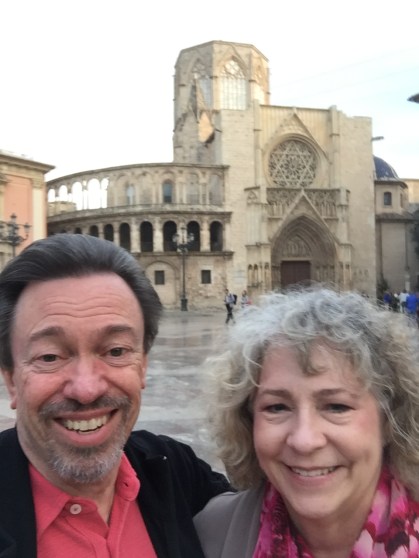
Valencia is larger than Alicante, with more than 800,000 people. We liked what we saw and think we could live there. It’s got a different feel, a stronger vibe, more energetic. Get out of the old city and you find City of Science and Industry, an attraction almost like a theme park that includes Europe’s largest aquarium, Oceanografic. We hope to see it on our next visit there.

Old city housing is similar to where we live here in Alicante. We didn’t get a chance to visit any modern areas, but the outskirts of the old city have newer buildings, and a hustle and bustle that’s similar in ways to downtown Chicago.

The next day, we spent some time in the Cathedral of Saint Mary, built between the 13th and 15th centuries, with additional work done over the centuries since. img_1223When we arrived in the plaza to meet our tour, we thought the building was a synagogue because the stained glass window includes the Star of David, as you can see in the photo (right). On the tour, though, we learned it was designed as a tribute to Jesus having been Jewish.

There are a number of chapels that contain precious works of art, including two Goya paintings. In one chapel, the left arm of St. Vincent the Martyr — patron saint of Valencia — is on display. And in the most important chapel, we saw the Holy Grail. Yes, THE Holy Grail, the cup Christ used at the Last Supper. Always skeptical, I did some research later. One brochure says this cathedral’s claim is actually quite strong. It seems other potential Christ cups have been debunked, but they claim the jury is still out on this one. Anything’s possible, I suppose.

Heading out of town, we were really impressed with Estacio del Nord, the train station that handles most regional traffic. The other station is for the high-speed AVE trains to Madrid. Nord is impressive, as you can see. Built in 1917, the tile work is incredible, inside and outside.img_1209

This weekend we plan to visit two smaller towns just up the coast from Alicante: Altea, which we once considered for a base, and Vila Joiosa which we’ve only learned about since being here. More on that later.


Finally, it seems that everywhere we go, we run into a wedding. Remember I told you about the wedding at Edinburgh Castle that stumbled upon us back at the beginning of the journey? And when we were in Greece a year ago with Educational Opportunities, I took some shots of a photographer shooting a wedding on the island of Santorini. Well, we were just about to leave the plaza outside the rear of the cathedral in Valencia when I turned and saw this couple. Weddings are everywhere, it seems. We hope they will be very happy together.img_1218