Do you know what Mexican Turkey is?

A quick update while we are sitting by the pool, enjoying nice breezes and recovering from a couple of journeys with Vallarta Adventures (see “Whale of a Tale”), the tour company Leslie and I really like.

Before I tell you about those trips, another plug for US Global Mail, the Houston company that handles our mail for us, and for shipping service DHL. This week the mail included a new credit card to replace one that expires in May, and a check. Most of our mail gets thrown away or scanned to store on my laptop, but I needed that credit card, as well as the check. DHL got it here in just two days — a day sooner than promised — and at a discount thanks to US Global Mail. DHL makes it easy to track the shipment and their website is user-friendly.

The check is from International Living magazine, the first of many I hope to receive from them and similar publications. IL recently used an article I wrote about our vagabond lifestyle, so I am now a travel writer!

And our daughter Stephanie was here over Easter weekend to celebrate her birthday (April 14), along with her friend Kelly. The two of them often bunk together on group travel excursions, so they appreciated having their own rooms in our three-bedroom condo!  We celebrated Steph’s birthday at Puerto Vallarta’s top-rated restaurant, Tintoque, right down the street from our condo. The next night, we took them to Victor’s in the marina. A more casual, fun place known for free tequila shots. Stephanie was aghast when she arrived Friday night to find that her mother’s tan was better than hers. She and Kelly spent much of weekend trying to fix that.

Victor's-0828
Victor welcomed us to his restaurant and gifted Stephanie (left) and Kelly with a bottle of his uncle’s famous tequila. Steph says it will stay at her place, but Kelly expects a shot whenever she visits. Happy Birthday, Stephanie!


It was great to see her again. If we decide on Mexico rather than a European country as our retirement home, it will be easier for Steph to come see us from her home in San Diego, and vice versa.

This week we went on excursions to Yelapa (pronounced gel-AH-pah), a small coastal village accessible only by boat, and to the silver mining town of San Sebastian.

At Yelapa, we saw a neat waterfall, walked through the town, relaxed on the beach and tasted some incredible raicilla, which is made — like tequila — from the agave plant, and is distilled only here in the state of Jalisco. Very smooth.

IMG_0839
This waterfall greets you as you complete a climb up Yelapa’s hill. Some in our group took a dip in the pool.

Vallarta Adventures staff, especially the amazing tour director Pablo, kept us entertained all the way there and back on the boat – about 90 minutes each way. Just before lunch, Leslie and I got a chance to paddle a sea kayak around a pretty little cove. First time for both of us! Lunch was a make-your-own sandwich buffet. Leslie pointed to one of the choices and asked a crewman, “What is this?” With a straight face he replied, “Mexican turkey. Brown pelican.” Then he winked. It was just regular turkey, of course. I wonder how many times a week he uses that one!

On the cruise back to PV, Pablo and the staff performed — OK, lip-synced — some old rock ‘n’ roll standards as “The Mexican Rolling Stones,” complete with makeup and props. Having an open bar helped us enjoy it a bit more, but those guys put on a great show. They were very funny!
IMG_0860
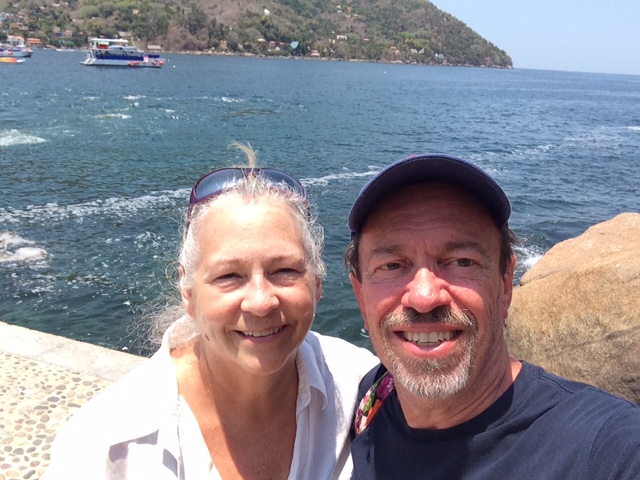
Got a selfie in as we prepared to board the boat back to Puerto Vallarta. Yes, that’s my Cubs cap — sorry the “C” doesn’t show. I wore it one day on the beach at the PV Marriott and met a guy who said he was once a Cubs bat boy. He knew Ernie Banks! Had fun talking with him.

Yesterday’s excursion was by van, over narrow, winding roads through the Sierra Madre Mountains to the silver mining village of San Sebastian del Oeste. Tour guide Gabriel kept up a running commentary on a variety of topics, including bits of Mexican history. San Sebastian was once home to some 30,000 people while 90 area silver mines were operational. Now the mines are gone and there are only about 600 residents. The town, with its narrow cobblestone streets and whitewashed homes, hasn’t changed much since the 1910 Mexican Revolution drove many people away, primarily the upper classes. It is one of more than 100 places the government has designated as a Magical City, or Pueblos Mágicos.

We visited Hacienda Jalisco, where silver ore was refined in the 18th and 19th centuries.

IMG_1691
Hacienda Jalisco. At least one website claims this may have been one place where Elizabeth Taylor and Richard Burton hooked up during filming of “Night of the Iguana.” Our guide didn’t mention it, though.

Once owned by the great film director John Huston, some of it has been restored. You can see the smelters where ore was baked in one of the steps to create pure silver. After a terrific lunch at the Secret Hotel (“secret” because you can only stay or eat there if you know the owner), we saw a family-owned organic coffee roasting operation. The family matriarch, “Mary,” had 21 children. We bought some of the coffee from a gentleman known as “veinte” (Spanish for 20) because he’s the 20th child, and he looked to be close to 70 years old. The video below is the roasting part of the process. Yes, it smelled fantastic!

Error
This video doesn’t exist

The formal walking tour ended at the home of the Encarnación family, which has lived in this house since the 1700s. Part of it is now a museum. Then we spent some time in the beautiful church just off the plaza, and saw a silversmith’s shop. Both our guide and the silversmith admired Leslie’s silver necklace. Her father brought that necklace home from a business trip to Mexico almost 40 years ago. Gabriel said the craftsman who made that style of jewelry passed away a number of years ago, and they don’t see his work very often. Gabriel was impressed.

Last stop, fortunately, was a visit to Hacienda Don Lalin, a local tequila distillery. After a brief introduction by our host, Lalo (who grows his own agave plants), we tasted some very fine tequila, mezcal and raicilla, as well as amaretto- and coffee-flavored tequilas. Once again, we contributed to the local economy and hit the road back to Puerto Vallarta.

IMG_1741
Lalo is a third-generation tequila distiller, and his products are very tasty. The labels say “Don Lalin,” who was Lalo’s grandfather. 

One more week here in this bustling Mexican beach town. Then Leslie and I move on to Mérida, capital of the state of Yucatan. It’s 10- to 20-degrees hotter there, but we’ve heard great things from a number of people about that colonial city.

Hasta luego!

San Miguel is Number One. Just like the Chicago Cubs!

Back when I was working, my good friend and colleague John Peterson and I always made it through depressing pro football and basketball seasons in Chicago by saying, “How long until spring training?” (OK, the Blackhawks are winners, but neither of us understands hockey!) Well, spring training has begun anew. And this year, the Cubs are defending World Series Champions!!!

The Cubs are Number One, and apparently so is San Miguel de Allende.  No, we haven’t reached a final decision, but if we had to choose today our retirement home would be SMA. Will we be here  when the Cubs win the 2017 World Series? Can’t answer that one yet. We’ve still got several places to see.

We’re both a little surprised that we like Mexico so much. I always felt that our primary focus for a retirement home would be Europe, probably Spain, and it might still be that. So why is San Miguel the leading contender right now?

img_1358
The iconic Parroquia, the beautiful parish church that dominates SMA’s “skyline.” As the sun shifts during the day, the colors change. So it looks different in the afternoon than in the morning.

The climate here is just great — warm and dry. It’s been as low as 69º F. and as high as 81º F. for daily highs, with humidities usually below 50 percent. And there’s very little rain this time of year. In the six weeks we’ve lived here it has rained twice, both times at night and only briefly. Local expats tell us that during the “rainy season” it either rains at night or for an hour or two in the afternoon. All-day rain or thunderstorms — very rare. Yes, it gets cool at night, but it rarely gets into the 40s until the wee hours, like 4 or 5 a.m. We’re snug in bed then. And in the dead of summer, daytime highs are slightly higher but nothing excessive because we’re at 6,200 feet altitude. Those who have been here awhile say to expect highs in the mid to upper 80s and lows around 60º F. We can handle that!

San Miguel, as noted in earlier posts, has an extensive arts scene with concerts, plays, operas, ballets, films, lectures and tons of art galleries. Many restaurants have live music on the weekends. One of our friends at St. Paul’s Anglican Church — and a long-time expat — put it best when he said, “I try to limit cultural events to one per day.” St. Paul’s is yet another reason to choose SMA. Good group of people there, and we like the rector, a retired Episcopal bishop from the States. There are also a number of charities here with many opportunities to volunteer. So we could stay pretty busy if we lived here. Or not.

Another person from St. Paul’s told us she has a good friend in the real estate business and can help us find a long-term rental. Lots of people come down here for six to nine months and rent their homes when they’re not here.

img_1371
This is a boveda ceiling in one of SMA’s many churches. Lots of buildings have this unique brick work ceiling. It’s even in some homes. Go here to see a two-minute video showing how they do it.

Then there’s the food. We love the fresh local produce we get at the mercados, and the meat we get at the carnicieras. But SMA also has a ton of great restaurants, from hole-in-the-wall chicken joints with locals lined up out the door, to high-end places with top-flight international chefs and stunning views. One could never go hungry in San Miguel.

International Living magazine touts Mexico as 2017’s top retirement country. Last year, I think, it was Panama. There are a lot of positives about San Miguel, and about Mexico in general:

  • Mexico boasts one of the strongest economies in the western hemisphere right now.
  • It’s close to the U.S., so we can get back relatively quickly and without great expense in case there’s a family emergency.
  • Health care here is excellent, as we noted with Leslie’s visit to the podiatrist. And we have friends who always see a dentist while they’re here to get crowns and root canals — just as good as in Chicago at one-third the cost, they say.
  • There are many creature comforts in Mexico, like theaters, shopping centers, good cell phone and internet coverage. In the cities, even the small ones, there’s nothing third-world about this country.
  • The cost of living in general is low, especially if you pay in pesos. Friday morning we met another couple at a popular breakfast spot and had a lovely meal for a little over $500 pesos — about $25 USD. For FOUR people.
  • There are a lot of other expats here, mostly from the U.S. and Canada, but some from the U.K. and other countries.

OK, what are the downsides:

  • There are a lot of other expats here, mostly from the U.S. and Canada, but some from the U.K. and other countries. No, that’s not a mistake. Too many gringos is a problem. It tends to drive prices, especially home prices, higher.
  •  We will need to learn more Spanish. We’re getting by OK with limited knowledge, but if we’re going to live here we need better command. And we would have to do that if we chose Spain, too.
  • We’ll have to adjust to time here, and how things are done. This is Mexico, things don’t always go as smoothly and perfectly as in the States. Even though they don’t do siesta here in San Miguel, mañana is a way of life. You have to be patient sometimes.

    img_1365
    Traffic can be a problem in SMA, but drivers are much more courteous here than in the U.S.

So we have a lot to think about. But now it’s on to the beach town of Puerto Vallarta on Mexico’s Pacific coast. We have already connected with the expat community there, and we’ve signed up for a dinner on Thursday night after we arrive Wednesday afternoon. This group has lots of social events like dinners and happy hours — every week!

The condo we’ve rented from a Canadian guy named Hal is very different from all the places we’ve lived in on this trip. It’s a modern townhouse in a gated community called Marina Vallarta. It’s on a fairly busy street, but it backs up to a golf course. We have three bedrooms and a huge outdoor area with a plunge pool. It’s nowhere close to the historic centro. We will be able to walk to the marina area and to the beach, but we’re unsure about how to access the local produce in farmers markets, as were able to do in Spain and to a lesser extent in Malta. Hal says taxis and buses are plentiful and cheap. We’ll be in Vallarta for two months — all of March and April.

Next post from Puerto Vallarta!

44552eb3-10e9-4c99-b0f2-1fa8eec84026
Go Cubbies!


CUBS WIN! CUBS WIN!

Just a brief pause in this travel blog to celebrate something not related to travel, or Spain, or retirement. Bigger, some might say.

The Chicago Cubs won baseball’s World Series for the first time since 1908! Just so you know, I grew up in Arkansas watching the St. Louis Cardinals on TV — on Saturday or Sunday afternoons — with my dad. They were the closest major league team, so that’s the team we saw on our TV. One great memory of my dad: Whenever a batter came up in the eighth or ninth inning and the announcer said he was “oh-for-four” or “oh-for five,” my dad would always say, “Well, he’s due.” Invariably, the batter would get a hit.

I lost interest in baseball when I wasn’t picked for a Little League team. I think that was 1960. Flash-forward to 2000 when Leslie and I moved from San Antonio to the Chicago suburbs and I landed a job with the U.S. Environmental Protection Agency. Having a cubicle right next to Mick Hans, and working closely with Sue Pastor, I quickly became a Chicago Cubs fan. Not long-suffering like those mentioned, but a fan. And I did love my lengthy Cubs-related conversations with fellow editor John Peterson.

Today, in glorious retirement, Leslie and I spent some time on the beach here in Alicante, Spain. Yes, on Nov. 4 we were on the beach. Here I am:

44552eb3-10e9-4c99-b0f2-1fa8eec84026

Luggage space is highly limited when you’re packing for a 10-month trip over three seasons, so I only brought the cap. I wore it one day in Barcelona and was approached by someone who recognized the logo. Fist bump.

Today I wore it proudly, even though most of the other people on the beach were speaking Spanish, French, Italian or Russian. I’ll wear it again tomorrow. Proudly.

So what was the U.S. like in 1908? Teddy Roosevelt was president, Henry Ford produced the first Model T and Thomas Selfridge became the first person to be killed in an airplane crash. Grover Cleveland died and Lyndon B. Johnson was born. Mark Twain was still alive, as were Harry Houdini, Florence Nightingale and the Wright Brothers. None of them, however, saw the Cubs win that year.

So even though I am many miles from Chicago today, I’m excited about this historic win. Let’s do it again next year, guys!

Fly the W!


Settling in to the Spanish lifestyle. The siesta is alive and well in Alicante!

img_1186Buenos tardes from our apartment, or “piso” in Spanish. Here’s a photo (right)  of our end of Calle Mayor in the Cosco Antiguo, the Old City of Alicante. I have yet to learn how old the buildings are in this area, but much of the city was destroyed by cannon fire from English ships in 1691, so most are likely 18th or 19th century, although a few older structures survived the battle. More history later.

The Cosco Antiguo, as you can see, has narrow streets, some of cobblestone. Just wide enough for one car, or most likely for two hombres with their burros to pass each other. Vehicle access is restricted to those with special permits.

Below is a shot of our building, Calle Mayor, 43. It’s a very comfortable apartment with two bedrooms and two baths. We’re in piso 1 on the first floor, but European “first” floors are what we would call the second floor in the U.S. Here, though, when you enter from the street you are on the ground level, or floor 0. We’ve checked out the rooftop terrace, from which we can see most of the Cosco Antiguo and Centro barrios, and just a small part of the Mediterranean Sea. Looks like a great place to hang out with a glass of wine in the afternoon.img_1188

It’s about 1600 as I write this. If you were in the military, or if you’ve spend much time in Europe, you will recognize that as 4 p.m. Lunch is over and siesta has begun. Most shops, and some restaurants, close around 2 or 3 p.m. and re-open after 5 or 6 p.m. Spanish families generally have their main meal of the day at lunch, anywhere from 1 to 3 p.m., then a light dinner or tapas after 8 or 9 p.m., often followed by a stroll through the plaza or down the rambla. It’s not unusual for tapas bars to be full of people at midnight or even later. We’re not fully acclimated to siesta yet (although Leslie is napping right now!) but we think it’s highly civilized!

We started our day early today (Friday, Oct. 28) with a walk along Alicante’s most popular beach, Playa del Postiguet, for sunrise at about 8:30 a.m. Lots of local folks were out, too. Some were jogging, some walking dogs, a few were even swimming. We were very comfortable in T-shirts. High today, about 74 degrees F. Here’s what it looked like this morning during our walk: img_1184

Later we roamed through Central Mercado, an indoor market place with hundreds of vendors selling fresh fruits and vegetables, meats and cheeses, seafood, and pastries. This is where the people of central Alicante come to buy food.

The fruits and vegetables area brought to mind our Saturday mornings at the Downers Grove farmers’ market the past several summers. But this was much bigger, with more vendors. At one stall, we picked up some lemons, apples, celery, broccoli, potatoes, a big red pepper and a bunch of seedless grapes– all for 8 euros, less than $10.

We still have some exploring to do in our temporary home, but so far we like Alicante. Hey, it’s been almost a week and we have yet to turn on any AC or heat. We could get used to this.

Adios!