Year Two begins with one more stop in Mexico: Ajijic

midway-47
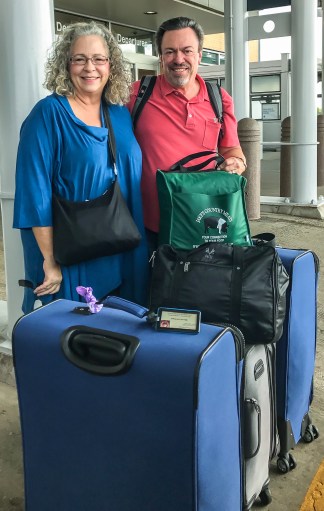
Leaving Midway on a direct Volaris flight to Guadalajara. A little better prepared than a year ago, and still advertising for Jake’s Country Meats!

First, let me assure you we were completely unaffected by the earthquake that killed more than 230 people in five Mexican states, primarily in Mexico City. We are a little over 330 miles from Mexico City, so we did not feel the quake here in the Lake Chapala area.

And a correction: Last post had a pronunciation guide for Ajijic, but I got it wrong. Sort of. There is some debate. One source says “ah-he-HEEK,”  but the locals often drop the hard “c” at the end, making it “ah-he-HEE.”  

Ajijic is a 450-year-old village where the cost of living is relatively low and the climate is “the best in the world.” This town is at roughly the same latitude as Hawaii and the same elevation as Denver. Average temperature is 68 degrees F. It’s near the end of the rainy season right now, and daytime highs are in the high 70s to low 80s with overnight lows in the low 60s. The humidity seems to run from 50 percent up to near 80 percent after a storm.

Like San Miguel de Allende, Ajijic has narrow cobblestone streets and a central plaza. There are a number of colorful shops, art galleries and restaurants in the centro. Population numbers vary but 15,000 seems to be a good number, with at least a quarter of that being retired expats, mostly from the U.S. and Canada. Some live here year-round, many more stay through the winter before heading NOB (north of the border) for the rainy season. There are several other villages along Lake Chapala — Jocotepec, Chapala and San Antonio Tlayacapan just to name a few.

Lake Chapala is Mexico’s largest freshwater lake. It’s 50 miles long and 11 miles wide, at its extremes, with an average depth of about 15 feet. Ajijic’s “Malecon,” or boardwalk along the lakefront, is a great place to jog/walk in the mornings. I often see egrets, herons and pelicans on the shores.
IMG_1842
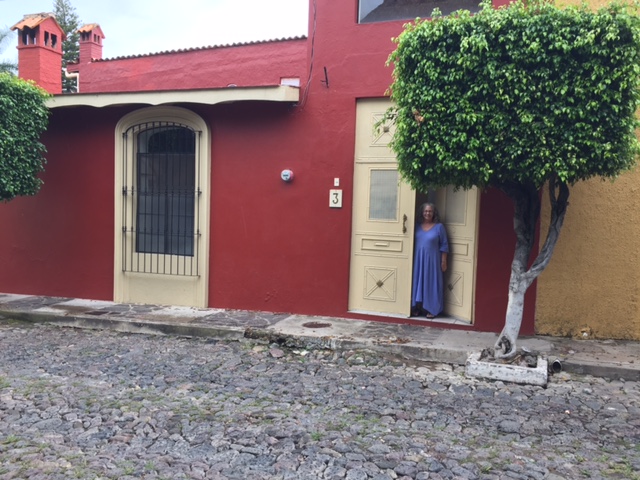
Traditional house on a cobblestone street.

Leslie and I have settled into our new digs, a very nice home on Donato Guerra street in the central section of Ajijic. We have two bedrooms (family and friends can come visit!) and a patio with a pool. There’s a good bit of street noise and a few mosquitos, but the house is terrific. Some of that street noise is the clip-clop of horses’ hooves. Yes, you can see locals on horseback here almost any day of the week. The kitchen is probably the best-equipped we have seen in our travels.

kitchen-1847
Leslie has already whipped up some great meals here!

And we have four female roommates: Audrey, Doris Day, Racer and Bean (photos below). They must think we’re okay, since they sleep in our laps and ask for belly rubs. Thanks, Anita and Ken, for letting us live in your home for the next few weeks!

We have become members (through the end of October, at least) of the Lake Chapala Society so we can take advantage of their many social and educational offerings, and meet more people here. They help expats with health and legal issues, offer personal enrichment classes, and sponsor bus trips to the shopping mall in Guadalajara. LCS has lots of things for expats, but they also sponsor ESL classes for local people who want to improve their English. Our friend Marlene, who has lived here almost two years now, is a volunteer ESL teacher.

I’ll leave you with pics of our four housemates.

Hasta luego!

IMG_1841
Audrey has her own chair! Her name is on the heart-shaped medallion.
IMG_1830
Bean, short for “String Bean,” can open the patio door by herself, but never closes it.
IMG_1829
Racer, short for “Speed Racer,” loves belly rubs.
IMG_1833
Doris Day, a tiny kitty who loves to cat around outside at night, but is always at the patio door seeking entrance when I get back from my morning walk/jog.


Break’s over — back on the bus!

Tomorrow afternoon (Thursday, Sept. 14), Leslie and I begin the second year of our two- or three-year plan to find a new home — a place to retire where the weather is always warm (or mild, at least). No more snow. No more sub-zero Chicago winters.

We’ve both gotten clean bills of health from our various physicians and we’re ready to go back on the road.

Over the past year we’ve been through eight countries, 12 airports, eight train stations and four bus stations. We’ve stayed in eight different homes or apartments we found through Airbnb or VRBO, and in nine hotels, including the one we’re in now. We’ve slept in 21 different beds.

Since returning to the States we have dined with old friends, attended our church and readjusted the storage locker at U-Stor-It in Lisle, Ill., containing all our worldly goods.

2E93CA9B-0A7B-4DC3-BFF6-7C96AD777FA3
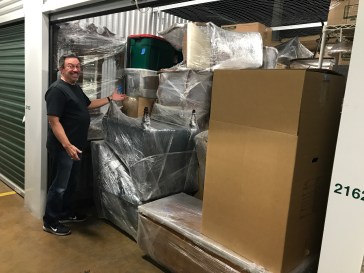
Leslie and I worked ALL DAY to move our stuff into this big storage unit.

We moved the contents of a large unit and a small unit into one huge unit, and (we think) more properly stored our king-sized memory-foam mattress. We also made two more trips to Goodwill and one to a consignment shop.

Many thanks to Bill and Linda for hosting us for two weeks at the end of July. Their lovely home offered a great re-entry into the U.S. for Leslie and me. We could only pay them back with a nice dinner of Fish Veracruzano style, and by introducing them to rum and tonic, our favorite tropical drink.

Then we moved into the Hyatt House here in Warrenville. Hyatt House has been our home since Aug. 1 and we have mostly enjoyed it. The part we didn’t enjoy is when the fire alarms went off and we had to leave the building. It happened much too often — and there was never a fire. We think it’s people cooking in their rooms without turning on the vent over the stove. The smoke detectors are very sensitive.

IMG_1822
Hyatt House in Warrenville.

This hotel offers a two-room suite, so we have had a bedroom/bath separate from the living area and kitchen. The hotel has a good location, comfortable bed, well-equipped gym, nice patio with gas grills and an excellent breakfast. One of the best things about the Warrenville Hyatt House is Patricia, a cheerful Guatemalan woman who makes amazing omelets every weekday morning. She’s always got a smile for all the guests, even though her back is hurting from being on her feet for over two hours.

We had fun visiting our friend Judy in her new place at The Lakes at Waterford. We were so taken with her bright, spacious two-bedroom, two-bath duplex that we met with the sales director! It’s a place we might think about as a “Plan C” a few years from now (Plan “B” is living in San Diego, close to our daughter). It’s something to consider if the idea of living in other countries loses its luster or if we just feel we need to be back in our old stomping grounds. We think the costs are low enough that we could live there in spring, summer and fall, while getting to a warmer climate for winter.

I know what you’re thinking. When we told Bill and Linda we were considering Waterford, Linda was speechless. Slack-jawed, in fact! But we’ve gotta consider all the options, right?

Now we’re headed back to Mexico to spend about six weeks in Ajijic (ah-HEE-hick), on the shores of Lake Chapala just south of Guadalajara. More on that once we get there.

This time next year, we expect to either decide on our new home or at least narrow the choices down to two cities and spend six months in each. The way we make decisions, though, it could actually be three finalists and four months in each!

Thanks for following us! I hope you will enjoy reading about our exploits in places to come: Costa Rica, France, Italy and who knows where else!

F0586C9E-908D-46B5-9132-686ED9F85485
The best neighbors anybody could want! We had a ball catching up with Dan and Zdenka (we just call her “Z”).
52E8735B-F65F-4AD8-B6B8-3D90EC51E625
Leslie got to spend some time with both sisters, Laura (center) and Cathy, who flew in from Florida for a few days.


Playa del Carmen: For a vacation maybe, but not long-term

Leslie and I love the beach. Since we moved to Chicago’s western suburbs late in 2000, most of our vacations have been on Caribbean islands. In February. It helped us survive Chicago winters.  So it seemed natural that a place like Playa del Carmen, right on the Caribbean Sea, would be a strong candidate to be our new home. Wrong. We would love to come back here for a vacation, but living here permanently is out.

There are some positives. Let’s look at those first:

  • It’s a small city, only about 150,000 people, and relatively walkable if you live between the beach and Highway 307.
  • There’s a lot to do here. Playa is a major tourist destination, so you can visit Mayan ruins, swim in cenotes and go to water-related theme parks on the Mayan Riviera. Oh, and there’s the beach. We will miss our wait-person Luis at Kool Beach Club. He tried to teach us some Spanish: “Estamos bien, por ahora.” (We’re good, for now.)
  • Excellent restaurants, and not just in the tourist areas. And not just Mexican food, either. We had terrific gazpacho and paella last night at Mar de Olivo.
  • Good public transportation, especially the vans they call colectivos, which will get you around town and to other cities on the Mayan Riviera. Lots of taxis available, too.
avocado-1770
One great thing about living in Mexico: BIG avocados, some of the best we’ve ever had. Less than $2 USD for a pound.

But the negatives are strong:

  • We’re looking for warm temperatures and Playa has that. But the humidity is 80 to 90 percent or more. We’re tired of sweating constantly when outside. The deodorant works, the antiperspirant does not. It wasn’t so bad when we were here seven years ago in December but again, we’re looking for a year-round home.
  • We’ve been unable to find an English-speaking church. In three other Mexican cities, we have thoroughly enjoyed attending Anglican church services weekly and meeting some terrific people.
  • As a consequence, we’ve been unable to meet other expats. There doesn’t seem to be any organized group here as there were in San Miguel de Allende and Puerto Vallarta, and to a lesser extent in Mérida.
  • We’ve also been unable to find any cultural events, such as concerts or lectures we might want to attend. This town appeals to a younger, hipper crowd. One of the biggest annual events is the DJ Festival at Mamita’s Beach.
  • Playa is a big-time tourist trap. We gringos cannot walk peacefully down Fifth Avenue. We are assaulted by people selling tours, fishing trips, diving trips, cenote trips, tacky souvenirs, Cuban cigars and lots of other stuff. “Vivimos aqui, amigo,” (We live here, buddy) usually works, but it’s easier just to avoid the street.
  • And as mentioned in a previous post, it seems most of the housing is vacation rentals rather than traditional Mexican homes for more permanent residents. Prices seem a little on the high side.
  • Did I mention the humidity?

So we’ve learned that the Yucatan Peninsula is not for us. Great for vacations, but not more.

tierra-96
Madre Tierra is one of the few restaurants we remember from our Christmas vacation seven years ago. I enjoyed one of the best steaks I’ve had in years.

We’ve been on the road for nine months now. Time to take a break and head back to the U.S. to take care of things that need our attention and to see friends and family. Our flight from Cancún lands at O’Hare tomorrow afternoon (Saturday, July 15). We will be in the area until the end of August and possibly for the first week or two in September.

What happens after that? You may recall from a previous post that Leslie and I visited the Lake Chapala area for a few days at the end of March to reconnect with an old friend from Texas. At the time, I said this deserved a closer look. So we’ve secured a two-bedroom house in Ajijic for mid-September through the end of October.

Ajijic is similar to San Miguel — high altitude (5,000+ feet), warm days, cool nights, low humidity. The expats who live there say it’s the best climate in the world. And we really liked their downtown weekly farmers market. It will be our fifth, and probably final, Mexican home. Leslie wants to try Ensenada in the northern part of Baja California. I think it’s too close to the border, which is where a lot of the drug cartel activity is. We’ll see.

After that, we’ll be in San Diego for November and December. That lets us spend the holidays with our daughter Stephanie, and it gives us an opportunity to see what it would be like to live there. It is possible, after all, that someday we would want to be closer to her. Knowing, however, that moving in with her for two months would be nearly impossible, we have secured an East Village condo about three blocks from her place.

As 2018 begins, we plan to check out a couple of highly recommended towns in Costa Rica’s Central Valley, and then do another three months in Europe — France and Italy are on the agenda, but we may also try another city in Spain. This time next year, it will be decision time. Where will our new home be? Vegas oddsmakers are already hard at work!

Next post from the U.S.


Lake Chapala: Best climate in the world?

Leslie and I took one of our side trips this week to check out a place we’ve heard has “the best climate in the world.” It’s the Lake Chapala (chah-PAH-lah) area, about an hour south of Guadalajara. We were only there for a day and a half, but we’re going back because this area is now on our list.

We visited the town of Ajijic (ah-HEE-hick) to renew an acquaintance from over 20 years ago. Leslie and I knew Marlene Syverson when we all attended University United Methodist Church in San Antonio, Texas.


IMG_1499
Our old San Antonio friend Marlene at the Wednesday morning mercado in Ajijic. 

Marlene left Texas in 1994, but kept in touch through the years with Joan Ahrens, who was singles pastor at UUMC at the time (and a key force in getting Leslie and me together). Leslie read one of Joan’s Facebook posts recently, in which she said she had visited Marlene in Lake Chapala. Surprise!

So we spent five hours on a plush, first-class double-decker bus through the Sierra Madre Mountains to Guadalajara, Mexico’s second-largest city. We had primo seats at the front of the upper deck, with great views of lush valleys, extinct volcanos and huge fields of agave plants (main ingredient in tequila). A 45-minute taxi ride from the new Guadalajara bus station got us to Ajijic, a quaint little town similar in many ways to San Miguel de Allende.

IMG_1488
Make you hungry?  The climate means local farmers can grow crops year-round.

Marlene took us to the Wednesday mercado in Ajijic (some of the best produce we’ve seen, plus meats and fish!) and showed us several towns and neighborhoods, including Ajijic, Chapala, San Juan Cosala and San Antonio, where she has lived (yes, a little bit ironic) for a little over a year. Some are stunning, high-dollar homes with sweeping vistas, and some are quaint little Mexican houses with lots of character. We caught up with Marlene and learned more about her life in Mexico.

So what did we find? Lake Chapala itself is beautiful. It’s the largest lake in Mexico and is natural, not man-made. Small towns like Ajijic ring the lake, with gringos living mostly in Ajijic, Chapala and San Juan Cosala. We expected to find beaches and lots of boats, but there are no beaches and only the gringos paddle around in kayaks, Marlene being one of them.

IMG_1466
Lake Chapala. It’s really much bigger than it looks here. Marlene says there is a volcano on the other side of that prominent mountain. Some days, she can see smoke rising.

Best climate in the world? Well, International Living says the region has “one of the best.” This is due partly to “lake effect,” with Lake Chapala acting as a moderating force on highs and lows. And there are mountains north and south of the lake, helping ameliorate storms. Temperatures are in the 70s fairly consistently throughout the year, with the annual average between 75° and 78° F. Add in low humidity and a brief rainy season, and it’s hard to beat. That’s similar to what we found in San Miguel, but in SMA it can get pretty chilly at night — down into the low 40s — and the daytime temps can vary with the seasons. Also, Ajijic is at 5,000 feet altitude, a little over 1,000 feet lower than SMA. Closer to Denver-type altitude. The rainy season begins in mid-June, but most of the rain comes at night and is not constant. Long-time resident expats say it might rain every three days or so.

The cost of living here appears to be quite low.  Marlene left the mercado with a huge bag of vegetables that cost her the equivalent of $5 US. Leslie was lusting after the beautiful heads of red- and green-leaf lettuce, but we had no way to get it home!

I checked a couple of rental agencies in Ajijic and found some two-bedroom, two-bath homes and apartments available for under $1,000 US a month on a long-term rental. And some of them have views of the lake!

IMG_1468
Ajijic’s malecon. I can see myself jogging on this esplanade every morning!

If you don’t mind being outside the centro you can rent a nice home for $500 US per month or less. Houses for sale run the gamut, some are on the market now for $100,000 US or less. Marlene says property taxes can be as much as $100 US per year. That’s right – per year. Propane gas appears to be fairly costly but electricity is not, especially since you don’t need air conditioning.

There’s more, but I will revisit the Lake Chapala area in-depth in a later post. Much later. Leslie and I are thinking we will spend a couple of months in Ajijic next year, probably mid-January at least through the end of February, maybe longer. We want to be in Ajijic for the Festival de Febrero, a classical music festival formerly known as Northern Lights Music Festival.  We got to know two of the festival’s biggest backers, Canadian expats Tony and Roseann — their son produces the festival every year.

So it was a great visit with Marlene and an enlightening tour of the Lake Chapala area. We will be back.

But we still have one month here in Puerto Vallarta, and lots more to see and do. Next time, I hope to focus on the cost of living here.

Hasta luego!