Spain is more than just Alicante

Leslie and I have been living in our Alicante apartment for a little over a month now. Some days are like today: rainy and chilly. So we just stay home and read our books or work on planning our next vagabond move. There have only been a few of those days, although it seems the rainy season may actually be here now. And when I say “chilly” I mean highs around 62º or 63º F. The locals are bundled up in winter coats, while we put on a light jacket or a sweater. Most days, we’re out doing something, like going to Central Mercado for groceries or visiting one of several local museums.

But we also realize that we need to get out of town and see more of Spain. Last week we hopped on an early morning train for Valencia and did an overnighter. Valencia was one of the cities we considered living in for an extended period. It’s famous as the birthplace of paella, and we wanted to see what the “real thing” tastes like. To do that, we found, takes some planning. You need a car to get out into the countryside and find a place that cooks paella outside, over an open fire. That’s the Valencian way. And we learned that true Valencian paella does not include seafood, just chicken, rabbit and sometimes snails.

We took advantage of a walking tour to see the historical sites in the old city, and we got a tip from our tour guide about a nearby restaurant — not a tourist trap — that does Valencian paella. It was great. We definitely needed a siesta after that meal! We’ve had several different kinds of paella now. I can’t decide on a favorite.

The walking tour covered the major tourist sites, such as the cathedral, the archeological museum with its Roman ruins, the Central Mercado and the narrowest building in Europe. img_1206This building is only one meter wide. Really. Take a look (left). One meter. That’s not quite 3.3 feet. And people actually lived in it a few centuries ago. Today it’s just for tourists to gawk at. Most of it has been reworked so that it’s part of the building next door.

Valencia is larger than Alicante, with more than 800,000 people. We liked what we saw and think we could live there. It’s got a different feel, a stronger vibe, more energetic. Get out of the old city and you find City of Science and Industry, an attraction almost like a theme park that includes Europe’s largest aquarium, Oceanografic. We hope to see it on our next visit there.

Old city housing is similar to where we live here in Alicante. We didn’t get a chance to visit any modern areas, but the outskirts of the old city have newer buildings, and a hustle and bustle that’s similar in ways to downtown Chicago.

The next day, we spent some time in the Cathedral of Saint Mary, built between the 13th and 15th centuries, with additional work done over the centuries since. img_1223When we arrived in the plaza to meet our tour, we thought the building was a synagogue because the stained glass window includes the Star of David, as you can see in the photo (right). On the tour, though, we learned it was designed as a tribute to Jesus having been Jewish.
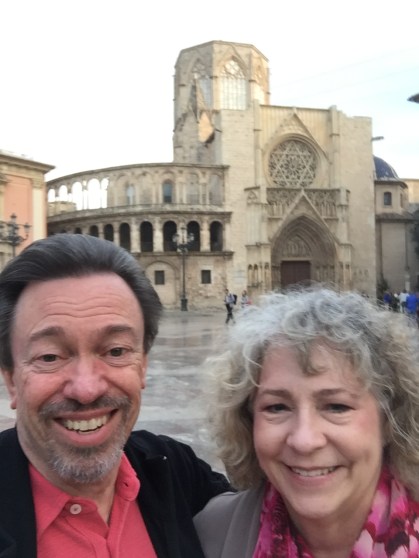
There are a number of chapels that contain precious works of art, including two Goya paintings. In one chapel, the left arm of St. Vincent the Martyr — patron saint of Valencia — is on display. And in the most important chapel, we saw the Holy Grail. Yes, THE Holy Grail, the cup Christ used at the Last Supper. Always skeptical, I did some research later. One brochure says this cathedral’s claim is actually quite strong. It seems other potential Christ cups have been debunked, but they claim the jury is still out on this one. Anything’s possible, I suppose.

Heading out of town, we were really impressed with Estacio del Nord, the train station that handles most regional traffic. The other station is for the high-speed AVE trains to Madrid. Nord is impressive, as you can see. Built in 1917, the tile work is incredible, inside and outside.img_1209

This weekend we plan to visit two smaller towns just up the coast from Alicante: Altea, which we once considered for a base, and Vila Joiosa which we’ve only learned about since being here. More on that later.


Finally, it seems that everywhere we go, we run into a wedding. Remember I told you about the wedding at Edinburgh Castle that stumbled upon us back at the beginning of the journey? And when we were in Greece a year ago with Educational Opportunities, I took some shots of a photographer shooting a wedding on the island of Santorini. Well, we were just about to leave the plaza outside the rear of the cathedral in Valencia when I turned and saw this couple. Weddings are everywhere, it seems. We hope they will be very happy together.img_1218


Church came to us this week. Complete with a brass band!

One reason for traveling to foreign lands is to experience other cultures. To see how other people live. Those of us afflicted with the travel bug are usually curious about how people live in other parts of the world. Here in Spain, daily life is — for the most part — similar to daily life back in Illinois. But there are some striking differences. More than just the siesta.

We haven’t been to church in a few weeks (I know, seems like a non sequitur but stick with me here), so this week, church came to us.

On Saturday night, about 8 p.m., Leslie and I were relaxing after a busy day; just reading our books and thinking about a nice salad for dinner. Then we heard music coming from somewhere — sounded almost like a drum and bugle corps, but playing in a minor key. The living room window overlooks a short street that leads to a small plaza, and we can’t see much from that window. As the music got louder, we put our shoes on and headed downstairs to see what was the matter (getting in the Christmas spirit there).

What we saw was this: img_1315From a distance, it looked like a parade float. But as it came closer we could tell it was a platform bearing a statue of Jesus carrying his cross to the crucifixion site. It was probably 20 to 30 feet high. There were flowers on the platform and candles on each corner. It was coming toward us, right down Calle Mayor, accompanied by an impressive procession of people with banners and long metal poles, each topped by a Jerusalem cross. And right behind the float was a brass band, playing what sounded like a dirge.

When the procession passed our apartment, we fell in with other people and followed. It ended at Basilica Santa Maria, the Roman Catholic church just a block or two from where we’re living. It’s the oldest church in Alicante, built between the 14th and 16th centuries. The people carried the platform by placing long poles on their shoulders. They were very close together and completely in step.  I counted 42 in front and 46 in back. With the massive church doors open, as you can see in the photo (left) img_1299they carried the platform right inside. This solemn procession was very impressive, and quite moving.

We watched the band milling around in the plaza outside the basilica and it seemed they were waiting for something. Sure enough, after about 15 or 20 minutes, those carrying the Christ statue brought it out of the church, turned it around with some deft maneuvers, and went right back up Calle Mayor to the Plaza Santa Faz.

Leslie and I felt like we had been to church — or rather, that church had come to us! I hope you’ll be able to see this 2-minute video and hear the band, but it was dark and all I had was my iPhone. I shot the video as they left the church, and at the end you can Basilica Santa Maria. Cue the bells!

Error
This video doesn’t exist

Now, I’m not Catholic so I can’t say this with total certainty, but I doubt you would see anything like this in a U.S. church. This is one of those cultural events that we can only appreciate through travel to other countries, and becoming immersed in other cultures. We’ve asked around but still don’t know exactly why this event was happening. We know it was something the Santa Maria congregation does regularly.

As the procession made its way away from the church, I noticed one priest on a cell phone. Maybe he was talking to the pope, who knows. And I noticed one little trumpet player in the band who was very determined. Looked like he was marching next to his father.img_1321

img_1319

Just one more note on the band — and how many churches in the U.S. have a brass band for cryin’ out loud — some of the instruments looked like bugles, but with valves. Now, I played trombone in the high school band, so I know my brass. But I have never seen anything like these valved bugles. Not valves like on a trumpet or cornet (I saw both of those instruments, too), but valves nonetheless. Maybe they’re historic. Who knows?

Are there downsides to other cultures? Of course. We’ve noticed that lots more people smoke in Europe. And they smoke in outdoor seating at restaurants, which is annoying to those of us accustomed to fully non-smoking restaurants.  It was true in the U.K. and also here in Spain. They don’t always clean up after their dogs, either.

But experiences like the Saturday night procession remind us why we travel, why we try to get a feel for what people do in other countries. When we learn about other cultures, we grow and expand our horizons. When we learn about other cultures, we often see more similarities than differences. When we learn about other cultures, we tend not to mistrust them or fear them.


Alicante is the best place in the world!

That’s actually the city’s official motto, as we learned today from guide Maria. She led our little group on a walking tour from the waterfront through the old town and up to Central Mercado, pointing out landmarks and giving us quite a history lesson.

Alicante has a troubled past. Lots of death and destruction in the War of the Spanish Succession and later the Spanish Civil War. This city was on the losing side in both conflicts. But since the mid-20th century — and especially since the 1980s —  things have gotten progressively better. Tourism has created many jobs, helping the population grow to more than 300,000. Now when you look northwest from the heights of the Castle Santa Barbara, you see a thriving city that feels good about itself. Hence, the motto.img_1278

While a few historic structures remain, most of the city’s buildings are 20th and 21st century. Alicante was bombed repeatedly by the fascists in the Spanish Civil War, and it became the last Republican city opposing Franco’s forces. Many of those who opposed Franco escaped Spain from the port of Alicante, which you can see in this photo, also taken from Castle Santa Barbara. The old city is prominent also. Just right of center, you may be able to see the blue domes of Co-cathedral of St.Nicolas. Stunning from the inside. It dates to the 1600s, but has been renovated several times, once following a fire.img_1286

In an earlier post, I wrote that I didn’t know the age of the apartment building we’re in. Update: Only about 60 years old, according to its owner, but the foundations are over 200 years old. That’s why the streets are so narrow. Some buildings in the area are older, such as the Alicante City Hall and Basilica Santa Maria, both of which survived bombardments from sea and air.

Central Mercado also survived an aerial bombardment on 25 May 1938. But 300 civilians were killed when bombs fell on the plaza just north of the market. A plaque in the plaza floor commemorates that tragic event.

On a cheerier note, Maria explained that tourism started taking off here when Scandinavians discovered Alicante’s beaches. At the time, though, highly restrictive dress codes for women prohibited bikinis. Even into the 1960s! So a delegation traveled to Madrid and petitioned the Franco government for relief. The Scandinavians won’t come  if the women can’t wear bikinis on the beach! And did we mention how much money tourists bring into the city? So the government eased off, and the tourists are still coming today. Here’s part of the main beach on Friday, Nov. 11, from Castle Santa Barbara. img_1289

So the people here think this is the best place in the world. Is it the best place for us to retire? Hey, this is our first stop. And we’ve only been here three weeks. Let us check out some other places.

But it’s definitely on the short list.


The good life in sunny Spain

Today, Leslie enjoyed getting a pedicure at a nail salon here in Alicante. We found this place online, then stopped by yesterday afternoon and made the appointment. You should understand that she really liked getting her toes done at Karma in our former hometown of Westmont, Ill. So going to someone else, especially someone who  does not speak English, was a big question mark. I think Leslie has a new favorite nail tech! They managed to communicate just fine, and the pedicure was slightly less than at Karma, just 25 euros.

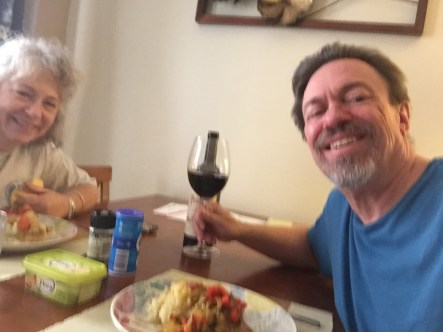
We’re trying to be like locals, so Leslie is cooking our main meal at midday, which for Spain is around 2 p.m. We have a big dinner, what we would call “lunch,” between 2 and 3 p.m., with a glass of red wine. Then we enjoy siesta until 5 or 6 p.m. Sometimes that’s an actual nap, sometimes it’s reading a book, or taking a walk or working on a blog. Many shops close between 2 or 3 p.m. and 5 or 6 p.m., then reopen until 8 or 9 p.m. Siesta is very civilized. Here’s one of those midday meals, a favorite of mine and one of Leslie’s amazing creations: Spanish steak baroness, along with a 2012 crianza from Protos winery in the Ribera del Duero region of Spain.img_1189

OK, the selfie’s not that great, but the meal was incredible!

Most Spaniards have their evening meal as late as 9 or 10 p.m. Something light like tapas. I’ve been making dinner salads for us almost every evening, usually about 7: 30 or 8 p.m. That was our lunch back in the States. Having a light meal before bedtime is, we think, healthier.

We usually dine at home, but some evenings we go out for tapas and a glass of sangria. And a few times we’ve had the midday meal at a restaurant, taking advantage of the menu del dia. For a fixed price, often less than 10 euros per person, you get an appetizer or soup, entree, wine and dessert.

We’re buying food at a couple of different places, but the most interesting is Central Mercado on Avenida Alfonso X El Sabio. Built in 1911-12, it’s a cavernous old building with  modernist architecture and tilework. Seems like hundreds of vendors on two floors, selling fruits and vegetables, meat, fish, eggs, cheese, etc. Like the Downers Grove farmers’ market on steroids, but indoors and all year ’round. Prices are even better than the farmers’ market, too. And if we don’t know the Spanish name of something we just point to the item and ask, “Como se dice esta en Espanol?” This morning, Leslie pointed to the broccoli and asked that question. “Broccoli,” the vendor smiled. Sometimes it’s easy.

Another great thing about this part of the world: We’ve been here a little over two weeks now and have not used heat or air conditioning in the apartment. Most days, the windows are open. It’s been a little cool the past few evenings, but most it’s usually at least  22 degrees in the afternoon, and the coolest overnight so far has been 10 degrees. Remember, they use the Celsius scale in Europe so that would be a high of 70-plus and a low of 50. And very little rain.

One more month here in Spain,  then we move on to the island nation of Malta for another month. We’ve heard lots of good things about Malta, and can’t wait to check it out. The original plan was to go to France or Italy next. But even southern France is a bit chilly this time of year. And our preferred location in Italy, the Amalfi Coast, was a logistical nightmare. So we opted for Malta and we’re still hopeful our daughter Stephanie will be able to join us for Christmas.

On Jan. 15, we must leave the Schengen Zone. Options include hanging out for three months in the UK, Ireland or Croatia, or something more exotic such as Cyprus or Israel, then back to Europe proper. The current Plan A, though, is to come back to the New World, probably to Montevideo,Uruguay, where it is now summer!

That could change, though.We’ll keep you posted.


CUBS WIN! CUBS WIN!

Just a brief pause in this travel blog to celebrate something not related to travel, or Spain, or retirement. Bigger, some might say.

The Chicago Cubs won baseball’s World Series for the first time since 1908! Just so you know, I grew up in Arkansas watching the St. Louis Cardinals on TV — on Saturday or Sunday afternoons — with my dad. They were the closest major league team, so that’s the team we saw on our TV. One great memory of my dad: Whenever a batter came up in the eighth or ninth inning and the announcer said he was “oh-for-four” or “oh-for five,” my dad would always say, “Well, he’s due.” Invariably, the batter would get a hit.

I lost interest in baseball when I wasn’t picked for a Little League team. I think that was 1960. Flash-forward to 2000 when Leslie and I moved from San Antonio to the Chicago suburbs and I landed a job with the U.S. Environmental Protection Agency. Having a cubicle right next to Mick Hans, and working closely with Sue Pastor, I quickly became a Chicago Cubs fan. Not long-suffering like those mentioned, but a fan. And I did love my lengthy Cubs-related conversations with fellow editor John Peterson.

Today, in glorious retirement, Leslie and I spent some time on the beach here in Alicante, Spain. Yes, on Nov. 4 we were on the beach. Here I am:

44552eb3-10e9-4c99-b0f2-1fa8eec84026

Luggage space is highly limited when you’re packing for a 10-month trip over three seasons, so I only brought the cap. I wore it one day in Barcelona and was approached by someone who recognized the logo. Fist bump.

Today I wore it proudly, even though most of the other people on the beach were speaking Spanish, French, Italian or Russian. I’ll wear it again tomorrow. Proudly.

So what was the U.S. like in 1908? Teddy Roosevelt was president, Henry Ford produced the first Model T and Thomas Selfridge became the first person to be killed in an airplane crash. Grover Cleveland died and Lyndon B. Johnson was born. Mark Twain was still alive, as were Harry Houdini, Florence Nightingale and the Wright Brothers. None of them, however, saw the Cubs win that year.

So even though I am many miles from Chicago today, I’m excited about this historic win. Let’s do it again next year, guys!

Fly the W!


Settling in to the Spanish lifestyle. The siesta is alive and well in Alicante!

img_1186Buenos tardes from our apartment, or “piso” in Spanish. Here’s a photo (right)  of our end of Calle Mayor in the Cosco Antiguo, the Old City of Alicante. I have yet to learn how old the buildings are in this area, but much of the city was destroyed by cannon fire from English ships in 1691, so most are likely 18th or 19th century, although a few older structures survived the battle. More history later.

The Cosco Antiguo, as you can see, has narrow streets, some of cobblestone. Just wide enough for one car, or most likely for two hombres with their burros to pass each other. Vehicle access is restricted to those with special permits.

Below is a shot of our building, Calle Mayor, 43. It’s a very comfortable apartment with two bedrooms and two baths. We’re in piso 1 on the first floor, but European “first” floors are what we would call the second floor in the U.S. Here, though, when you enter from the street you are on the ground level, or floor 0. We’ve checked out the rooftop terrace, from which we can see most of the Cosco Antiguo and Centro barrios, and just a small part of the Mediterranean Sea. Looks like a great place to hang out with a glass of wine in the afternoon.img_1188

It’s about 1600 as I write this. If you were in the military, or if you’ve spend much time in Europe, you will recognize that as 4 p.m. Lunch is over and siesta has begun. Most shops, and some restaurants, close around 2 or 3 p.m. and re-open after 5 or 6 p.m. Spanish families generally have their main meal of the day at lunch, anywhere from 1 to 3 p.m., then a light dinner or tapas after 8 or 9 p.m., often followed by a stroll through the plaza or down the rambla. It’s not unusual for tapas bars to be full of people at midnight or even later. We’re not fully acclimated to siesta yet (although Leslie is napping right now!) but we think it’s highly civilized!

We started our day early today (Friday, Oct. 28) with a walk along Alicante’s most popular beach, Playa del Postiguet, for sunrise at about 8:30 a.m. Lots of local folks were out, too. Some were jogging, some walking dogs, a few were even swimming. We were very comfortable in T-shirts. High today, about 74 degrees F. Here’s what it looked like this morning during our walk: img_1184

Later we roamed through Central Mercado, an indoor market place with hundreds of vendors selling fresh fruits and vegetables, meats and cheeses, seafood, and pastries. This is where the people of central Alicante come to buy food.

The fruits and vegetables area brought to mind our Saturday mornings at the Downers Grove farmers’ market the past several summers. But this was much bigger, with more vendors. At one stall, we picked up some lemons, apples, celery, broccoli, potatoes, a big red pepper and a bunch of seedless grapes– all for 8 euros, less than $10.

We still have some exploring to do in our temporary home, but so far we like Alicante. Hey, it’s been almost a week and we have yet to turn on any AC or heat. We could get used to this.

Adios!


The vacation is over. Now we try out the Spanish lifestyle.

We are now in Alicante, Spain, where it’s nice and warm. No jacket required here! Our “vacation,” traveling through the UK and spending time in Barcelona, is finished. We have moved into our temporary quarters at Calle Mayor, 43, first floor, apartment 1. We are in the Casco Antiguo, or Old Town, with narrow cobblestone streets and very old buildings. Our apartment, however, is modern and cozy. More on that later.

First, a bit about Barcelona, since this is partly a travel blog. We visited the Gothic Quarter and walked down the famous Rambla. Some of the shops and restaurants are for locals, while some are just there to take the tourists’ money. Fascinating to see the stalls in the Mercat de Saint Josep de la Boqueria. You can buy candies, pastries, seafood and the Spanish “jamon iberico,” the thinly sliced cured ham that comes only from black Iberian pigs. Sabroso!

But the highlight of any trip to Barcelona is seeing Sagrada Familia. This is the cathedral designed by Catalan architect Antoni Gaudi. Construction began in the late 1800s and continues today. You can see construction cranes in any photo you take of this building. The authorities say they expect completion in 2026.

It’s unlike any church or cathedral anywhere. You’ve probably seen photos of the soaring spires, the crazy architecture and the modern statues depicting the life of Christ. img_1240But your jaw drops when you go into the basilica and look up.

Gaudi designed the stained glass windows differently for the east and west sides of the basilica. On the east side, struck by the morning sun, he used blues and greens. Cool colors. On the west side, he went with warm colors of red, yellow, orange. The difference is stunning.

We were there about 3:30 p.m. The sun coming in those west windows was dazzling. So bright I could not get a good photo. Here are the east windows.img_1252


Heavily influenced by nature, Gaudi designed the supporting pillars in the center of the church to look like trees. You can see how the branches spread out as they approach the ceiling. Yes, I did get a little dizzy looking up, but you have to look up!img_1253

Then there are the statues on the two main facades. They are stark and modernistic. The photo below shows Christ on the cross, but looking up toward Heaven, not down as in most crucifixes. Below that are Roman soldiers, but they appear to be wearing midaeval style armor. On either side of this sculpture are statues of Judas, who betrayed Jesus, and Peter, who denied Him. This facade is all about Christ’s death. The opposite facade is about the Nativity.img_1275

Barcelona practically worships Antoni Gaudi. You can see more of his buildings throughout the city. His unfinished cathedral draws millions of tourists, and his style is now Barcelona’s style. Meanwhile, the English word “gaudy” means something that does not look stylish at all.

When Gaudi died in 1926 in a tram accident, thousands attended his funeral. He is buried in the crypt section of his cathedral. He saw the structure as his gift to God.He once responded to a critic who thought the work was taking too long, saying, “My client is not in a hurry.”

The crypt, below the main level, is actually the only place were services are held. There is an altar set up there, and priests say mass daily. There is also a small chapel behind the nave set aside for prayer. Leslie and I spent some time there, and it was awesome.


A great day at Raventos i Blanc: Vineyards, mules, sparkling wine and our friend Pepe

Two years ago at the Hinsdale Wine Shop, we tasted some fantastic Spanish wines and met the winemaker, Pepe Raventos of Raventos i Blanc. We told Pepe back then that we hoped to relocate to Spain in about two years, when I retired. He signed one of the bottles we bought that night, “See you in two years!”

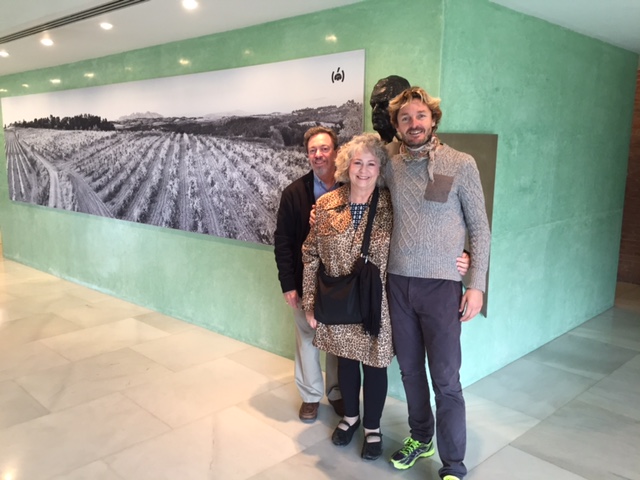
It took a little more than two years, but today we saw Pepe again when we spent a few hours touring his family’s estate, about a 40-minute train ride west of Barcelona in Sant Sadurni d’Anoia. Pepe is the 22nd generation of his family to run this winery. His ancestors started out in 1497. That’s not a typo. Over 500 years in the same family.  Here we are with Pepe. The bust behind us is of Pepe’s grandfather.

img_1150

We saw some vines that are about 70 years old, as well as some new plantings, and we met the two mules that help out on the property. Our guide was Anna, a young English woman on Pepe’s staff who is highly knowledgeable about wines. She’s off next week to Hungary to promote Raventos wines in that country. img_1123

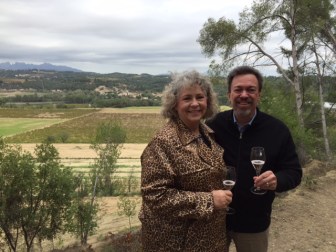
Anna treated us to some sparking wine as we  looked over the vineyards with Montserrat in the background, but nearly shrouded in clouds.  It was a bit chilly for this time of year.

Pepe is moving his family’s business into a more organic style called biodynamic. It’s almost as if he’s guiding his family’s business into the future by going back to techniques from its storied past. Please take a look at their website, http://www.raventos.com, to learn about biodynamics and their fabulous sparkling wine, or cava in Spain. I think you will be impressed with the materials on the website, especially the video. Definitely watch the video.

We know Pepe thanks to Sean Chaudry at Hinsdale Wine Shop. If you want to purchase some of their very fine wines, head for Hinsdale and tell Sean you’re friends of Mike and Leslie Rogers. I’m sure he’ll sell you some of Pepe’s good stuff.

img_1135img_1130

Two more days in Barcelona, then the vacation is over and we head for Alicante. There, we begin six weeks living in an apartment just off the central plaza (in Castilian Spanish, that’s pronounced, “plah-tha”) and only two blocks from the beach. We’ll be going to the markets like locals, walking around the plaza like locals, and visiting other places along the Costa Brava that could become our new home.

The vagabonding begins in earnest on Oct. 24!


Worshipping With Wesley

We decided to go to church Sunday. Surely there’s a Methodist church somewhere in London, right? So we rode the Tube to 49 City Road and attended the 11 a.m. service at Wesley’s Chapel. Yes. John Wesley, founder of the Methodist Church, built this church and preached here until his death. Here we are, shortly after the service ended. Our good friends at Grace UMC in Naperville will appreciate this the most. Today, we walked in the steps of John and Charles Wesley.

img_1068

This is an amazing place. Roughly half the congregation is African, many of the rest would fit right into the Forum Class at Grace! Being here was awesome. The Rev. Jennifer Potter gave an excellent sermon (not as good as Pastor Cindy, though!) from the high pulpit. In Wesley’s day, the pulpit was three times higher than what you see behind us here. That was so Wesley could see everybody, including those in the balcony, and be heard by all.

Following the service, we had coffee with some of the congregants. Wouldn’t be a Methodist church without coffee, would it? Then we went on a tour  with other visitors, including a group from Idaho. A volunteer showed us the church, the Methodist Museum, Wesley’s original Foundry Chapel (next door to the current church), Wesley’s home and his tomb. I won’t take up space here with details. If you want to know more, go to www.wesleyschapel.org.uk. The church was closed for a number of years and has been changed significantly from what Wesley built in the 1700s. For example, there were no stained glass windows then.  I’ll just add that it was pretty cool when I was able to stand in the same pulpit that John Wesley preached from. Wow!

Here’s that pulpit from the Foundry img_1071Chapel, now in the Methodist Museum. What’s still in the original chapel is the organ Charles Wesley used to write many of the hymns we still sing today.

In Wesley’s house, we saw the parlor and study, along with Wesley’s bedroom. All the rooms are very, very small. Much like the hotel room we’re in right now!

Here’s his study, complete with the chair he used, a replica of his preaching robe and the grandfather clock originally owned by Wesley’s parents. Notice that the chair is designed to be used as a normal chair, but Wesley also sat backwards on it so he could place a book on the img_1086small shelf, making study easier. The tour guide pointed out the size of the robe. Really short. Wesley was quite short, even for people in the the 18th Century.

Finally, here’s a shot of the church.img_1089


Let’s start with a vacation

Our quest for a new home will be delayed slightly because we need a vacation! So we’re doing touristy stuff in Great Britain beginning Oct. 5. The UK is not on our list of potential retirement locations, but we need to delay our entry in the Schengen Zone for a few weeks. Without a special visa, we can only stay in Spain, France and Italy for 90 days out of the next six months. It will be easier if that 90-day period begins in mid- to late-October.

So we depart for Glasgow, Scotland, on Oct. 4. We will visit Scotland, Wales and England to see the sites (Loch Ness, Hadrian’s Wall, Stonehenge, etc.) and to make pilgrimages to our ancestral homes. Leslie’s mother was part of the McAllister and Bloomfield families. We have identified their Northern Ireland hometown and are still looking for the original Scottish village from which they came. Mike is a descendant of John Rogers, who left his home in Laugharne, Wales, in 1635 at the age of 18 and ended up owning a plantation in Surry County, Virginia. We both have many Irish ancestors, too. We expect to visit that lovely island in the spring of 2017.

Once the vacation is done, we plan to take a train from London to Paris, then on to southern Spain to start the first phase of our vagabond existence. This is the scouting mission. At least a month in Spain and a month in France, and probably a month in southern Italy. If we find a great place, we’ll head back to the States and apply for the visa that will allow us to stay in our new home for a year or more. If the search doesn’t turn up a perfect retirement spot, we’ll move on to other countries. The scouting mission could last a year or more. We don’t want to rush this thing!

Please scroll down to the bottom of the page and click on the “Follow” button at the bottom right hand of the page. This will ensure (I think) that you get an email notification every time we update this blog.