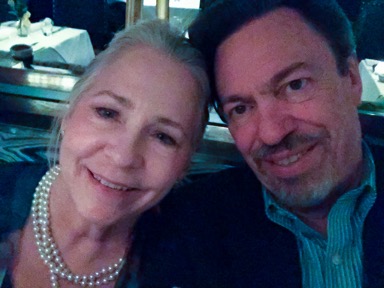
Last night, Leslie and I celebrated our 24th wedding anniversary with dinner at Chef Enrique Olvera’s Moxi Restaurant here in San Miguel de Allende. We enjoyed the tasting menu, or Menu Degustación, and a very nice bottle of Mexican wine.
Come see us! Nuestra casa es su casa!
Last night, Leslie and I celebrated our 24th wedding anniversary with dinner at Chef Enrique Olvera’s Moxi Restaurant here in San Miguel de Allende. We enjoyed the tasting menu, or Menu Degustación, and a very nice bottle of Mexican wine.
That’s what Stephanie said when we told her San Miguel de Allende was our next stop on the retirement tour. Turns out, she was here a few years ago with a group of friends for a wedding. And she was right — there are small art galleries on nearly every street in the Centro. Leslie and I have already been to two concerts and we’re debating about going to the opera next week!
Go just about anywhere in SMA and you’ll see posters advertising the many cultural opportunities here.  And every Friday we spend $15 pesos (not quite 75 cents) for a copy of Atención, the weekly English-language newspaper that includes a listing of all the cultural events in town.
There really is something for everybody. Here’s a sample:
You know we both love classical music. Last week we went to a recital by Misuzu Tanaka, an excellent young pianist with a commanding style. Remember that name — we think she’s going places. And on Thursday night we saw Amit Peled,  an Israeli cellist who plays a 1733 cello once owned by Pablo Casals. Amazing performance!
Both concerts were promoted by the local arts group Pro Musica. They are offering two more concerts while we’re here: the concertmaster of the Atlanta Symphony Orchestra for a violin recital, and a performance by the Amernet String Quartet (on my birthday).
If classical is not your thing, just wait until next week for the Encuentro Nacional de Jazz. It’s the 14th annual jazz festival, Feb. 7-11 at Teatro Angela Peralta. See? Something for everybody.
Last weekend, the Instituto de Allende — a five-minute walk from our apartment — hosted a two-day arts and crafts fair. Sure, there was a lot of stuff you would probably see at similar fairs wherever you live. And yes, some of them were expats selling hand-made jewelry. But there were some very nice things, too: wood carvings, paintings, photographs, wearable art. We spent some time there Saturday afternoon but didn’t buy anything. No room in our suitcases!
Finally there’s La Biblioteca. It’s a hotbed of cultural opportunities for expats. You can buy tickets there for most events in the city, and they host some performances, too. There’s an English-language library and a cafe where gringos hang out.
So we’re not starved for something to do here in SMA. On the contrary, we have to figure out which events we want to attend and which we can pass on. And if we were to live here full-time, we could certainly get involved in arts organizations or do volunteer work for some of the many charitable organizations that help families, children and animals.
Next time, more on the cost of living here in San Miguel. There’s good news and bad news. Hasta luego!


Show of hands, now — how many of you thought you would ever see Leslie riding a horse? I know you just can’t wait for the explanation, so here we go.
On Thursday, we went to Santuario Sierra Chincua, a monarch butterfly sanctuary high in the mountains about a three-hour drive from San Miguel. This is one of the places where the mariposa monarca spends the winter.

They migrate from Canada and the northern U.S. down to Mexico every year. Millions of them. And we spent a few hours with them.
Leslie and I went with five other people and Daniel, our driver. Getting there was not easy or fun. The van ride is very long and sometimes quite bumpy, and there’s not much to see along the way. But Daniel did a great job and got us to the sanctuary.
Sierra Chincua sits a little above 8,000 feet, and the difference in elevation is obvious — it’s cooler and breathing is slightly more labored, for example. We had a choice of walking up a dusty trail to where the monarchs were, or paying an extra 100 pesos to ride a horse. If you want to come back on the horse, that’s another 100 pesos. So we shelled out 400 pesos (about $20 USD) and we both mounted up. The horses were very gentle, and guides led us the whole way.
We dismounted after a 30-minute ride and walked a bit farther up a narrow trail into the forest. Soon we could see butterflies. They were in the trees, on low bushes and plants, flitting through the air. They were everywhere. They flew right past us sometimes.

Daniel taught us how to tell the difference between males and females, and he said many males die in the sanctuary after mating. He said that last year there was snow in the sanctuary, which is highly unusual. Many butterflies died. He also explained that birds eat dead butterflies, but only the body. The wings are toxic to birds. Sure enough, we found several places where wings were lying on the ground, but there was no butterfly body.
We could only see a small part of the sanctuary, which covers several acres. But in the small area where we were allowed to stand, we could look up into the sky and see them wafting around. We could look into the forest and see trees heavily laden with butterflies at rest. And there was no sound. All you could hear was the wind in the trees. Amazing!

Then it was time for a late lunch. Daniel took us to one of several small restaurants in the sanctuary compound, where he said the owner made a great mushroom soup. Several people, including Leslie, had the soup and all agreed Daniel was right! I had a potato and chorizo quesadilla, and it was fantastic. The hot sauce they served with it was great too. And really fresh hand-made corn tortillas — so much better than store-bought. Even better than our favorites, El Milagro.
Daniel explained that the local indigenous people make a living by taking care of the butterflies, and of the tourists who come to see them. They start as children, offering to watch your car for you while you’re spending time with the butterflies. As they get older, they work as horse wranglers or guides, or they do other work in the sanctuary, such as selling tickets or working in maintenance. Most don’t get paid much, if at all. They depend on tips, so our group tipped well.
According to Daniel, former Mexican president Vicente Fox provided substantial funds to build a nice entrance to the sanctuary, as well as quality buildings for restaurants and gift shops. This made the experience better for the tourists, and helped the people who work there.
Next time, arts and culture in San Miguel de Allende. Spoiler alert: There’s lots of culture!
So we bid farewell to the island nation of Malta. (The Maltese say “ciao” for goodbye. Their language borrows heavily from Italian as well as Arabic.) Lacking any temporary-residence visas, we can only stay in the Schengen Zone for 90 days. Tomorrow is the 90th day since we boarded a train in London and headed for Spain.
So we’re headed back to the New World to check out more possible retirement homes. First stop, later this week, is San Miguel de Allende in the mountains of Mexico’s Guanajuato province, about a three-hour drive north of Mexico City. It’s over 6,000 feet above sea level. Since we’ve been living for the past month at about six feet above sea level, this will take some getting used to!
We’re excited about being warm again. Malta is in the Mediterranean Sea, just about as far south as you can get and still be in Europe. But this winter has been unusually cold. It’s been that way all over Europe. The mountain air of San Miguel promises to be drier. While at night it’s in the low 40s F. right now, daytime temperatures are in the mid 70s. Can’t wait to have a margarita on the rooftop terrace of our apartment!
Right now, the plan is to be in San Miguel until March 1, then move on to Puerto Vallarta on the Pacific coast. Both towns have huge expat populations. Puerto Vallarta’s expat community is active and vibrant. We’ve already gotten a ton of emails inviting us to their social events. After about six weeks in PV, we plan to try Mèrida, at the northern tip of the Yucatan Peninsula, then possibly Playa del Carmen, just south of Cancun. We’re back in the Chicago area, probably by mid-July. Hope to see many of you then.
International Living magazine rates Mexico as the Number One retirement destination in the world for 2017. It’s partly the warm climate, partly the warm people. We’re hearing lots of great things about Mexico. Now, I know somebody is saying, “Gee, isn’t Mexico dangerous?” Well, it’s not nearly as dangerous as Chicago! Seriously, there are places in Mexico you should not go, like the Mexican states along the U.S. border and the state of Sinaloa. The drug cartels aren’t active in the areas we plan to visit. If they were, the tourists and expats would leave, taking their money with them. Then lots of good folks would lose their jobs. Where we’re going, it’s very safe. More on that later.
I leave you with a photo I took in Teatro Manoel in Valletta. It’s the third oldest theater in Europe, and the oldest in the former British Commonwealth. The concert we attended was titled, “Gallic Music for Cello and Piano.” The cellist was a young French artist, Sébastien Hurtaud. He was accompanied by Italian pianist Bruno Canino. We heard works by DeBussy, Fauré and Saint-Saëns. Leslie and I both enjoyed the performance, but spent the whole time thinking of our dear friend and outstanding cellist, Jo-Jo Murphy.
Next post from Mexico!

We have fewer than 10 days left here on Malta, so it’s time to start evaluating. There are a lot of good things to say about Malta. The biggest plus so far has been the ease of meeting other expats. We’ve enjoyed going to church at St.Andrews
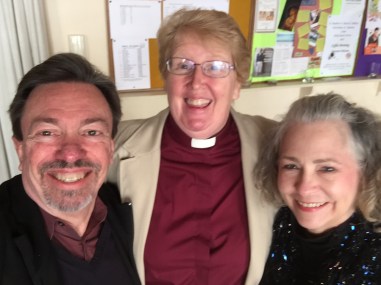
and have met some lovely people. In fact, Leslie and I had dinner last night at the home of our Canadian friends, Frank and Judy Wilmot.
Another plus is that most Maltese speak English, some better than others. Most signage is in English or a mix of English and Maltese. It’s generally pretty easy to make ourselves understood.
Culture is a big deal here — yet another plus. In fact, Malta will be the European Union Capital of Culture in 2018. They’re already promoting it. Beginning next week is the Valletta International Baroque Festival, a series of 25 classical concerts at various places around the capital city. We may get to see two or three before we leave. Malta also has an annual jazz festival and many opportunities to see theater and dance performances.
Leslie and I attended the President’s New Year Concert by the Malta Philharmonic Orchestra on New Year’s Eve at the Mediterranean Conference Center, which was built in the 16th Century by the Knights of St. John as a hospital. The orchestra was pretty good, as was the featured soloist, a young Maltese soprano, Nicola Said; the program mostly light classics and show tunes. And the president was there!

We were in the same room with the president of Malta, and we never saw any security. No metal detectors, no cops or soldiers with guns. Granted, the real political power here rests in the prime minister rather than the president. But she is far from a figurehead, being heavily involved in social issues of all kinds. I think it speaks well for this island nation that the president can mingle easily with the people.
There are also some things that aren’t that great. We noticed pretty quickly that it gets quite chilly here in December and January — and many Maltese don’t have heating or air conditioning in their homes. We have a dehumidifier in this 400-year-old house, which makes it feel more comfortable. Today’s high was only 50º F. with light rain and even some sleet, and tonight’s forecast low is 41º F. Up until today, it’s been more like 60º to 65º F. most days. Our neighbor came by this morning and said this is the coldest winter she can remember. Newer construction and renovated spaces often include heat and air conditioning, but running them costs quite a bit — electricity is expensive on Malta.
That’s just one part of what we’ve determined to be a slighter higher cost of living than what we found in Spain. Renting or buying property would be more expensive here. The biggest real estate agency lists apartments in Valletta for upwards of $315,000, and some of the better properties are well over $1 million. Here, on the older more historic side of The Grand Harbour, an area known locally as The Three Cities, some apartments are listed for under $160,000, and about the same in other parts of the island.
Surprisingly, we found some rentals available in St. Angelo Mansions, built recently just outside the walls of Fort St. Angelo — the only Malta fortification that withstood The Great Siege of 1565. We could rent a three-bedroom with water view there for anywhere from $1,100 to $1,600 a month. And in Valletta, we found rental listings for as little as $1350 a month for a two-bedroom. In communities nearer the center of the island, we found monthly rentals as low as $600 a month, also for two bedrooms. So there is some affordable real estate all over Malta.
Then there’s the cost of food. Just a few items from last week’s grocery list, all converted from grams and liters into U.S. measurements, and from euros to dollars at the current exchange rate. Bear in mind that without a car we don’t have easy access to an American-style supermarket. Our neighbor Marthese, who takes care of this house for the owner, took Leslie to the supermarket one day a few weeks ago, but most of our food comes from The Convenience Store (yes, that’s the name — it’s a local chain). With that in mind, here are the costs for you to compare:
Leslie says the cost of fresh fruits and vegetables from the greengrocer on Victory Street is slightly more than we paid at Central Mercado in Alicante. Same with meat and poultry. So in general, food costs are slightly higher here. Eating out in a restaurant is also a bit more expensive than in Alicante, with dinner menu prices rivaling what we paid at our favorite restaurants in DuPage County.
In general, we both believe Malta deserves continued consideration as a retirement home. We may come back to see how it is in a warmer season.
Our time in Europe is over for now. Next stop, Mexico. More on that next post.
I leave you with a photo of the nave and elaborately painted barrel vault of St. John’s Co-Cathderal, the number one tourist attraction in Valletta, built by the Order of St. John between 1572 and 1577, and dedicated to St. John the Baptist. In the 17th Century, the interior was redecorated in the Baroque style by Italian artist Mattia Preti and others. The church is considered one of the finest examples of high Baroque architecture in Europe and one of the world’s great cathedrals. The artwork alone is awesome.
In the last post I forgot to say Leslie and I had a great Christmas with our daughter, Stephanie. We enjoyed Christmas Eve dinner in our house and went to church Sunday at St. Andrews, where we sang carols and heard an excellent message from Pastor Kim Hurst.
After the service, we feasted on Christmas dinner with about 40 people from the church and the community. There were people from the U.S., the U.K., Ireland, Australia, Libya, Egypt, Nigeria and Malta, of course. Maybe a few others. We didn’t get to talk to everyone.
Our new friends Franklin and Judy cooked turkey and dressing with lots of potatoes and vegetables. Since they are Canadian, Judy called it, “a traditional North American Christmas dinner.” Here we are:
Now, Part Two of our private guided tours of Malta, conducted by Victoria, who did a great job. In the last post I detailed our visits to the Blue Grotto, two of the island’s megalithic temples and Casa Bernard. But there’s more!
We had a “Taste of Malta” experience that started with some Maltese coffee and traditional pastries. Didn’t like the coffee. It has anise in it, and I don’t like that flavor. Leslie liked it, but not enough to make it at home. The pastries, on the other hand, were very nice. We each had something different, and we also tried traditional nougat treats. For lunch, we dined at Diar Il-Bniet in the town of Dingli, a restaurant featuring food from a nearby farm. We asked Victoria about the menu and she said, “Everything they serve is food that Maltese people prepare at home.” Baked macaroni with minced beef, beef marrows, beef olive with Maltese sausage, and cauliflower lasagne. Probably the best meal we have had in quite some time. Maltese food is very flavorful!
But we did more than eat. We also walked through the walled city of Mdina, founded by the Phoenicians in the 8th Century and Malta’s capital until medieval times. Only a few hundred people live within the walls, mostly members of Malta’s noble class.
The biggest attraction in Mdina is St. Paul’s Cathedral. Originally built in the 12th and 13th Centuries, the cathedral was severely damaged in a rare earthquake in 1693. It was rebuilt in the Baroque style we see today. 
The Apostle Paul was shipwrecked on Malta while being taken to Rome to stand trial before Cesar, his right as a Roman citizen (see Acts 21-26 for the whole story). The cathedral is dedicated to him, and most of the art is about Paul, including a beautiful frescoe above and just behind the altar depicting the shipwreck.
St. Paul’s Cathedral is known for its Christmas “crib,” what we in the U.S. would call a nativity scene. Only this one is massive. There are so many people and animals in this crib that it’s hard to even find Mary and Joseph! It’s probably 12 to 15 feet across. This is a Maltese tradition. Many of the faithful have cribs in their homes, or in a display case right beside their front doors.
Here’s the cathedral’s crib — shepherds on the left, angels descending from Heaven:
In the close-up (below) you can barely see Mary, Joseph and the baby Jesus. Look near the center, then see the Magi just to the right of the baby:
We left the cathedral to visit the Mdina Glass factory, which is actually in the village of Ta’ Qali. Each piece the company sells is hand-made. We watched glassmakers working, effortlessly creating items like the ones on display in the shop. Leslie and Stephanie both contributed to the economy of Malta!
If you want to know more about the art they produce, click on the link in the previous paragraph.
Finally we visited Meridiana Wine Estate, also in Ta’ Qali, where we got a tour of the winery and did some tasting. This winery, and its vineyards, are on land that was a British airfield during World War II (see photo, below). Vines were planted and the winery built in the 1980s. Click the link above to learn more.
Leslie and I had tried some Meridiana wine at a wine shop in Valletta a few weeks earlier. We were surprised at how good Maltese wines are. Meridiana is our favorite, but there are other excellent wines here.
Our good friend Sean Chaudry at Hinsdale Wine Shop really needs to try and score some of their Isis Chardonnay. It’s one of the best chardonnays I have ever tasted, but I doubt it’s available to distributors in the States. Sean, your next trip should be to Malta! You won’t regret it. 
This photo (left) shows Leslie and Stephanie in the barrel room. We descended a tightly wound spiral staircase into the cellar and learned how their wine is fermented in stainless steel tanks and aged in French oak barrels, like these.
All their wines are named after Phoenician gods, such as the goddess Isis, previously mentioned. I know what you’re thinking — Isis was an Egyptian goddess! Well, it seems folks here on Malta think she was a Phoencian goddess first, and the Egyptians borrowed her. Either way, the wine named for her is stunning. Crisp and citrusy. Great with Maltese seafood.
Steph bought a few bottles, some red and some white, to ship home to San Diego. Leslie and I got a few bottles for ourselves because the winery price was lower than the Valletta wine shop price.
Since we don’t have a rental car, these tours gave Leslie and me a great chance to see more of Malta. And it was super entertainment for Steph. We all learned a lot.
But then it was time to say goodbye to our beautiful daughter. She took a very early morning flight to London on Dec. 29, and arrived safely — much to the delight of her two cats, Louis and Piper. Fortunately there was no hijacking this time!
Leslie and I plan to celebrate New Year’s Eve by attending The President’s New Year Concert by the Malta Philharmonic Orchestra. Then we will watch the fireworks. We haven’t decided where to go yet; there are several possibilities. We may join the crowds in Valletta’s St. George’s Square or watch from Upper Barrakka Gardens, near the underground bunkers where the Allies planned the Mediterranean campaign in World War II. Or, if it’s too cold, we may head back home to watch the fireworks from the Three Cities side of The Grand Harbour. We’ll let you know.
Happy New Year!
We had a little excitement today. As Leslie and I prepared for our daughter Stephanie’s arrival for Christmas, we heard about a hijacked airplane that had landed at the Malta International Airport. There was a possible hostage situation and the airport was closed. It turned out to be a Libyan airliner, hijacked while on a domestic route. Apparently this was a political act by supporters of the former dictator. It was not terrorism, and no one was killed or injured. The good news is, Stephanie’s flight from London Heathrow was only about 15 minutes late.
So she arrived safely and will be with us for a few days to celebrate Christmas. Leslie has a lot planned — we’re doing a walking tour of Valletta, the capital city, and a wine tasting, among other things. Maltese wines are very good — we’re trying to sample as many as we can!
Christmas Day we plan to worship at St.Andrew’s Church in Valletta, then join our new friends in the congregation for Christmas dinner.  Our Canadian friends Franklin and Judy are preparing traditional turkey and dressing with all the trimmings. This is a fun group, so it should be a great Christmas. So far we’ve met people from Canada, Egypt, Nigeria, the U.K. and the U.S. Quite an international group.
Here’s a look at the sanctuary (right). I think the building dates to the early 1800s.
There are Christmas decorations all over this island. The city of Mdina is known for works of art in blown glass. Just inside the city gates of Valletta, in front of the Parliament building, stands a Christmas tree made of Mdina glass balls — big ones, little ones, all kinds of sizes. It’s quite festive, and about 30 feet tall. T here are also lots of nativity scenes around Malta, some done by churches, some by businesses, some in front of private homes.
I saw an article — can’t remember where — in which Malta was touted as one of the best places in the world to spend Christmas. Makes sense, since better than 90 percent of the population is Roman Catholic. Nobody here says “Happy Holidays”!
Stephanie heads back home to San Diego after Christmas, but Leslie and I plan to celebrate New Year’s Eve here. Instead of joining the crowd in the square on Republic Street at midnight, though, we will be at the Mediterranean Conference Center for the President’s New Year Concert, featuring the Malta Philharmonic Orchestra. There are a couple of other concerts in the first two weeks of the new year that we hope to attend.
We’re here until Jan. 16, then we have to leave Europe because we don’t have the visa necessary to stay longer than 90 days. I explained the Schengen Agreement in an earlier post. It just means we will be heading to Mexico next, to the mountain town of San Miguel de Allende. More on that later, too.
It will be sad to leave our new neighbors here in Malta, though, especially our new best friends who live here, on these tiny boats, just across the harbor from us:
The one on the left is bigger than our house in Westmont was!
The boats on our side of the harbor are a lot smaller. We were chagrined, however, to learn that the American Dream is not dead, it’s for sale:
Merry Christmas!
Actually, a little cooler than we expected — and not in a good way. Leslie and I thought we would enjoy highs near 70 degrees F. on this island, but it’s about 10 degrees short of that mark — about the same temperature as Alicante. We can’t put our sweaters away just yet.
We’re dealing with a few other challenges in the 400-year-old house in which we’re living until the middle of next month. It’s in a town called Senglea, or L-Isla in Maltese. Here’s what the house looks like:
That’s the front door — the one on the left. It’s called Ave Maria and the address is 7 Triq-Is-Sirena. All the houses have names, most of them church-related in some way, as well as addresses.
We’ve been told the house was built by the Grand Masters. The full title of this ruling class is The Sovereign Military Hospitaller Order of Saint John of Jerusalem of Rhodes and of Malta, also known as the Sovereign Military Order of Malta or Order of Malta. It is a Roman Catholic lay religious order traditionally of military, chivalrous and noble nature, founded as the Knights Hospitaller in 1099, around the time of the First Crusade. Its claim to fame is that it is the world’s oldest surviving chivalric order. And that they developed the Maltese Cross. Yes, it’s still around. But Malta is an independent nation now, part of the European Union.
I’ve provided a few links here for you to find out more about Malta, if you like. It’s not on the vacation radar for very many Americans, but a lot of British tourists come here in the summer. This is the Wikipedia page. And here is the official tourism site.
But back to the house we’re in. The building was apparently once part of the city walls, and at one time it housed a convent. Now it’s been refurbished with all the modern conveniences. Except one. There’s no heat.
Most homes of this age on Malta don’t have central heat or air. So in the very short winter (I guess it’s just while we’re here) people run dehumidifiers to make the indoor air feel warmer. And it seems to work, too.
One upside to this house is the view. Walk out the front door and look to the right, and you can see part of the bay, with lots of boats moored. There are simple rowboats and water taxis — traditional Maltese design — and larger sailboats with 20- to 30-foot masts. Sleek, nice boats.  Then there are the super-yachts, moored on the other side of the bay. Several of these yachts are bigger than our house in Westmont was! Probably bigger than your house, no matter who you are!
If you walk along the waterfront (on the right in the photo), there are a number of small restaurants. All have outdoor seating so you can see the water and the boats, and watch the ferry head over to the capital, Valletta, every half hour. The trip over takes about 15 minutes by ferry, 20 or 30 by bus.
Walk down to where you see the white van parked, turn left and you can walk along the waterfront and see Valletta.
One downside to Senglea is that it’s built into the side of a hill. And since the house is pretty close to water level, we have to climb stairs to get to shops, the bus stop or the local ATM. It’s also very quiet. There are no other tourists here. Most visitors to Malta stay in Valletta, or in the town just north of Valletta, called Sliema. We plan to visit those places in the days to come.
Finally, this country has two official languages: Maltese and English, because the Brits owned this island for a very long time. Everybody speaks English, at least some English, but with a heavy accent in most cases, and not a British accent, either. Sometimes it’s hard to understand. Maltese is kind of a blend of Arabic, Italian, Spanish and English. It actually sounds Arabic, and a neighbor told me last night that Arabic-speakers can understand Maltese pretty easily. At least most of the signage is in both languages.
Now we get to explore this place and determine if it’s a possible retirement home. More to come…
First, a brief aside. Something happened yesterday that I did not think would ever come to pass. Someone other than my good friend Traci Sedlock cut my hair! Traci’s been cutting my hair for at least the past 10 years, probably longer. It had been over two months since my last visit with her at the end of September, and I looked pretty shaggy. So I found a pelequeria por hombres and got a corte de pelo. The guy did a pretty good job. Not as good as Traci, of course, but at least I look a little better now.
Phase One of this retirement adventure ends tomorrow. Leslie and I leave Alicante on Friday, Dec. 9, spend one night in Valencia, then catch a plane for Malta at noon on Saturday, Dec. 10. We will spend Christmas in a 400-year-old house built by the Grand Masters and once part of a convent. It’s in Senglea, or L-Isla in Maltese, and is across the bay from the capital of Valleta. More on that when we get there.
We have mixed emotions about leaving Spain and Alicante. We like the area and we’ve gotten accustomed to everyday life here — as it would be if we were to live here long-term. But we need to experience other options, so off we go. But first…
It’s beginning to look a lot like Christmas in Alicante, with decorations in the main streets, like this one that runs past city hall (below).
 It seems a little strange, but many of the signs in store windows say “Merry Christmas” in English! The city hall building, however, is decked out with holiday greetings in both Castilian Spanish (left) — a phrase you are no doubt familiar with — and Valencian (right), which, in case you can’t read it, says, “Bon Nadal.”


And they’ve opened an ice skating rink in the plaza right across from city hall. It was in the low 60s when I shot this brief video, and everybody’s having fun:
Plus, at a number of locations on city streets, vendors have opened temporary churrerias, where you can get traditional pastry items such as churros con chocolate and bunelos. Every time I pass one, I think of my dear friend and former coworker Yvette Pina, who always brought churros to work on potluck days.
Tuesday was Constitution Day, a national holiday marking the approval of Spain’s 1978 constitution by 88 percent of voters in a referendum. That’s when this country became a constitutional monarchy and a democracy. There was a parade through our neighborhood, with yet another brass band, yet another Catholic float carried by lots of people (this one has a pope on top, I think) and some very tall cartoonish figures that I believe are called fogueres. You can see them in the short Constitution Day videos I have attached below for your viewing pleasure. The celebration seemed to focus heavily on children, and included people young and old in traditional Spanish dress. This procession ended at the Co-Cathedral San Nicolas. Enjoy!
So it’s Adios, Alicante! The next post will be from the island nation of Malta.
 We spent the weekend in the small Costa Blanca village of Altea, about a hour up the coast from Alicante.
Altea has about 23,000 people, so it’s a lot smaller than Alicante. And it’s quite charming. This photo (right) was taken from the top of the hill that overlooks the newer part of the town. This is the waterfront area, with shops, restaurants, hotels and apartment buildings.
 But what’s fascinating about Altea is the old city. This is one of the prettiest places we have seen. In front of many of the white homes, there are flowering vines or bushes. Flowering in early December! And many of the front doors are painted bright colors, mostly blue.
It’s sort of what we’ve been looking for. In fact, Altea may very well be at the top of our retirement homes list.
The old city, or Cosco Antiguo, has very narrow streets. Steep, too. Some are just walkways, too narrow for even the smallest car. And all the homes are whitewashed, similar to the hillside villages you may have seen in the Andalusia region of Spain. Apparently it’s a leftover influence of the Moors from centuries ago. The old city is spread out over the side of the hill. At the top, where a castle once stood, is the iconic blue-domed church of Señora del Consuelo.
It’s a bit of a hike up the hill, as you can probably tell. We still think we could live here. We strolled past some homes in the old city that had rooftop terraces with views like the photo above. We gazed at those terraces and thought how nice it would be to sit on that terrace to watch the sunrise while enjoying that first cup of coffee. Or to sit up there in the evening with a nice glass of wine. That’s first-class retirement!
This little village is not on the radar for most travelers, particularly for most Americans. Lots of Brits come here, and lots of Scandinavians but very few from the U.S., and that’s too bad. We learned about Altea from our favorite magazine, International Living. We enjoyed reading about this little town and had to see it for ourselves. It did not disappoint.
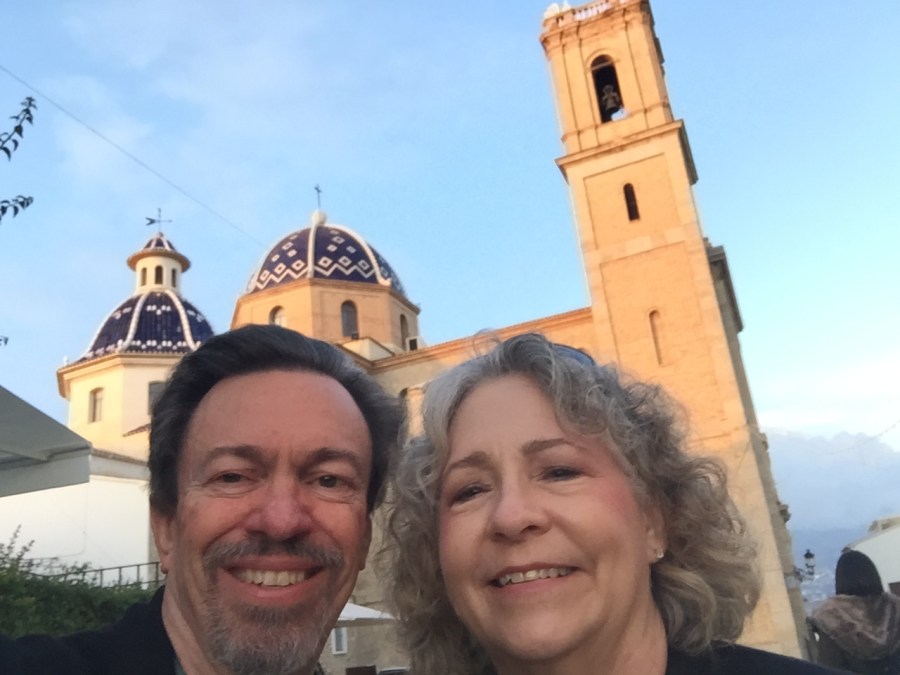
Here we are, in the obligatory selfie, in the plaza surrounding the old church. Could this be our new home???
 Ex-pats in Mexico