Different Parts of Malta, Part Two

In the last post I forgot to say Leslie and I had a great Christmas with our daughter, Stephanie. We enjoyed Christmas Eve dinner in our house and went to church Sunday at St. Andrews, where we sang carols and heard an excellent message from Pastor Kim Hurst.

After the service, we feasted on Christmas dinner with about 40 people from the church and the community. There were people from the U.S., the U.K., Ireland, Australia, Libya, Egypt, Nigeria and Malta, of course. Maybe a few others. We didn’t get to talk to everyone.

Our new friends Franklin and Judy cooked turkey and dressing with lots of potatoes and vegetables. Since they are Canadian, Judy called it, “a traditional North American Christmas dinner.” Here we are:img_1297


Now, Part Two of our private guided tours of Malta, conducted by Victoria, who did a great job. In the last post I detailed our visits to the Blue Grotto, two of the island’s megalithic temples and Casa Bernard. But there’s more!

We had  a “Taste of Malta” experience that started with some Maltese coffee and traditional pastries. Didn’t like the coffee. It has anise in it, and I don’t like that flavor. Leslie liked it, but not enough to make it at home. The pastries, on the other hand, were very nice. We each had something different, and we also tried traditional nougat treats. For lunch, we dined at Diar Il-Bniet in the town of Dingli, a restaurant featuring food from a nearby farm. We asked Victoria about the menu and she said, “Everything they serve is food that Maltese people prepare at home.” Baked macaroni with minced beef, beef marrows, beef olive with Maltese sausage, and cauliflower lasagne. Probably the best meal we have had in quite some time. Maltese food is very flavorful!

But we did more than eat. We also walked through the walled city of Mdina, founded by the Phoenicians in the 8th Century and Malta’s capital until medieval times. Only a few hundred people live within the walls, mostly members of Malta’s noble class.

The biggest attraction in Mdina is St. Paul’s Cathedral. Originally built in the 12th and 13th Centuries, the cathedral was severely damaged in a rare earthquake in 1693. It was rebuilt in the Baroque style we see today. img_1400

The Apostle Paul was shipwrecked on Malta while being taken to Rome to stand trial before Cesar, his right as a Roman citizen (see Acts 21-26 for the whole story). The cathedral is dedicated to him, and most of the art is about Paul, including a beautiful frescoe above and just behind the altar depicting the shipwreck.

St. Paul’s Cathedral is known for its Christmas “crib,” what we in the U.S. would call a nativity scene. Only this one is massive. There are so many people and animals in this crib that it’s hard to even find Mary and Joseph! It’s probably 12 to 15 feet across. This is a Maltese tradition. Many of the faithful have cribs in their homes, or in a display case right beside their front doors.

Here’s the cathedral’s crib — shepherds on the left, angels descending from Heaven:img_1410


In the close-up (below) you can barely see Mary, Joseph and the baby Jesus. Look near the center, then see the Magi just to the right of the baby:img_1411

We left the cathedral to visit the Mdina Glass factory, which is actually in the village of Ta’ Qali. Each piece the company sells is hand-made. We watched glassmakers working, effortlessly creating items like the ones on display in the shop. Leslie and Stephanie both contributed to the economy of Malta!

If you want to know more about the art they produce, click on the link in the previous paragraph.

Finally we visited Meridiana Wine Estate, also in Ta’ Qali, where we got a tour of the winery and did some tasting. This winery, and its vineyards, are on land that was a British airfield during World War II (see photo, below). Vines were planted and the winery built in the 1980s. Click the link above to learn more.img_1426

Leslie and I had tried some Meridiana wine at a wine shop in Valletta a few weeks earlier. We were surprised at how good Maltese wines are. Meridiana is our favorite, but there are other excellent wines here.

Our good friend Sean Chaudry at Hinsdale Wine Shop really needs to try and score some of their Isis Chardonnay. It’s one of the best chardonnays I have ever tasted, but I doubt it’s available to distributors in the States. Sean, your next trip should be to Malta! You won’t regret it. img_1423

This photo (left) shows Leslie and Stephanie in the barrel room. We descended a tightly wound spiral staircase into the cellar and learned how their wine is fermented in stainless steel tanks and aged in French oak barrels, like these.

All their wines are named after Phoenician gods, such as the goddess Isis, previously mentioned. I know what you’re thinking — Isis was an Egyptian goddess! Well, it seems folks here on Malta think she was a Phoencian goddess first, and the Egyptians borrowed her. Either way, the wine named for her is stunning. Crisp and citrusy. Great with Maltese seafood.

Steph bought a few bottles, some red and some white, to ship home to San Diego. Leslie and I got a few bottles for ourselves because the winery price was lower than the Valletta wine shop price.

Since we don’t have a rental car, these tours gave Leslie and me a great chance to see more of Malta. And it was super entertainment for Steph. We all learned a lot.

But then it was time to say goodbye to our beautiful daughter. She took a very early morning flight to  London on Dec. 29, and arrived safely — much to the delight of her two cats, Louis and Piper. Fortunately there was no hijacking this time!

Leslie and I plan to celebrate New Year’s Eve by attending The President’s New Year Concert by the Malta Philharmonic Orchestra. Then we will watch the fireworks. We haven’t decided where to go yet; there are several possibilities. We may join the crowds in Valletta’s St. George’s Square or watch from Upper Barrakka Gardens, near the underground bunkers where the Allies planned the Mediterranean campaign in World War II. Or, if it’s too cold, we may head back home to watch the fireworks from the Three Cities side of The Grand Harbour. We’ll let you know.

Happy New Year!

Seeing different parts of Malta

img_1323This is a view from above of the famous Blue Grotto on Malta’s southeastern coast, one of the places our daughter Stephanie wanted to see while she was here for Christmas. Leslie found a private tour company to help us all get a better look at parts of the island we haven’t seen.

See that itty-bitty boat down there? We got in one of those little boats (it only holds nine passengers, and you have to wear a life jacket) for a close-up view of an amazing place. Stephanie got a great selfie of the three of us:img_0035There are several caves and limestone structures on the 20-minute tour, but Blue Grotto is the star. Take a look at the incredible color of the water:img_1343

From the Blue Grotto, we drove past a rather large, somewhat isolated home that is often rented to the rich and famous who come to Malta for privacy. Our guide Victoria said the current occupant is Tom Hanks, although she did not know if he’s here to film a movie or just for vacation. Too bad he didn’t come out so we could say Merry Christmas!

Then we moved on to see the Hagar Qim temples, just two of the 23 megalithic temples found on Malta. They are the oldest free-standing structures in the world — 1,000 years older than the pyramids! This (below) is what the temple sites look like, covered by a tent to prevent damage from the elements. This is a UNESCO World Heritage site.img_1378

Unlike at Stonehenge, which is 2,000 years younger, the temple builders here used locally quarried limestone rock. There are two types in the area: a hard limestone and a softer limestone. Builders mainly used the soft variety because it’s easier to decorate. They also used it to draw their plans. Look at the two photos below. In the first, you see what might be considered an architect’s drawing. In the second, what the temple entrance looks like today.
img_1386

img_1387

Maybe my friend and international architect Larry Hartman can weigh in on the “blueprint”!

Just one more site to discuss in this post. We visited Casa Bernard in the village of Rabat. Built in the 16th Century, this was the home of a Maltese noble family of French origin. The current owners, Georges and Josette Magri, are not nobility but they have owned the house for many years and they still live in it. They open a portion to the public on a limited basis, but this is their home. They had a family Christmas dinner in the formal dining room. I think Josette said they had 40 for dinner, and yes, she had it catered!img_1391

She and Georges are collectors, as were both sets of parents. The place is like an antique shop. A very high-class antique shop! They have lots of small items to show off — pill boxes, match boxes, jewelry, china, silver services and other items. But there are also paintings on the walls that date to the 17th and 18th Centuries. A few are portraits of some of the Grand Masters of the Knights of St. John.

Our tour with Victoria continued to the walled city of Mdina with its glorious cathedral, to the famous glass factory outside of Mdina, and to the Meridiana Wine Estate. Malta has some outstanding wines. We tasted some at Meridiana. Stephanie bought half a case to be shipped to her home in San Diego. She will have the only Maltese wine in San Diego — maybe in all of California!

More on that next time! Happy New Year!

Malta is cool

Actually, a little cooler than we expected — and not in a good way. Leslie and I thought we would enjoy highs near 70 degrees F. on this island, but it’s about 10 degrees short of that mark — about the same temperature as Alicante. We can’t put our sweaters away just yet.

We’re dealing with a few other challenges in the 400-year-old house in which we’re living until the middle of next month. It’s in a town called Senglea, or L-Isla in Maltese. Here’s what the house looks like:img_1265

That’s the front door — the one on the left. It’s called Ave Maria and the address is 7 Triq-Is-Sirena. All the houses have names, most of them church-related in some way, as well as addresses.

We’ve been told the house was built by the Grand Masters. The full title of this ruling class is The Sovereign Military Hospitaller Order of Saint John of Jerusalem of Rhodes and of Malta, also known as the Sovereign Military Order of Malta or Order of Malta. It is a Roman Catholic lay religious order traditionally of military, chivalrous and noble nature, founded as the Knights Hospitaller in 1099, around the time of the First Crusade. Its claim to fame is that it is the world’s oldest surviving chivalric order.  And that they developed the Maltese Cross. Yes, it’s still around. But Malta is an independent nation now, part of the European Union.

I’ve provided a few links here for you to find out more about Malta, if you like. It’s not on the vacation radar for very many Americans, but a lot of British tourists come here in the summer. This is the Wikipedia page.  And here is the official tourism site.

But back to the house we’re in. The building was apparently once part of the city walls, and at one time it housed a convent. Now it’s been refurbished with all the modern conveniences. Except one. There’s no heat.

Most homes of this age on Malta don’t have central heat or air. So in the very short winter (I guess it’s just while we’re here) people run dehumidifiers to make the indoor air feel warmer. And it seems to work, too.

One upside to this house is the view. Walk out the front door and look to the right, and you can see part of the bay, with lots of boats moored. There are simple rowboats and water taxis — traditional Maltese design — and larger sailboats with 20- to 30-foot masts. Sleek, nice boats. img_1268Then there are the super-yachts, moored on the other side of the bay. Several of these yachts are bigger than our house in Westmont was! Probably bigger than your house, no matter who you are!

If you walk along the waterfront (on the right in the photo), there are a number of small restaurants. All have outdoor seating so you can see the water and the boats, and watch the ferry head over to the capital, Valletta, every half hour. The trip over takes about 15 minutes by ferry, 20 or 30 by bus.

Walk down to where you see the white van parked, turn left and you can walk along the waterfront and see Valletta.

One downside to Senglea is that it’s built into the side of a hill. And since the house is pretty close to water level, we have to climb stairs to get to shops, the bus stop or the local ATM.img_1270 It’s also very quiet. There are no other tourists here. Most visitors to Malta stay in Valletta, or in the town just north of Valletta, called Sliema. We plan to visit those places in the days to come.

Finally, this country has two official languages: Maltese and English, because the Brits owned this island for a very long time. Everybody speaks English, at least some English, but with a heavy accent in most cases, and not a British accent, either. Sometimes it’s hard to understand. Maltese is kind of a blend of Arabic, Italian, Spanish and English. It actually sounds Arabic, and a neighbor told me last night that Arabic-speakers can understand Maltese pretty easily. At least most of the signage is in both languages.

Now we get to explore this place and determine if it’s a possible retirement home. More to come…


Spain is more than just Alicante

Leslie and I have been living in our Alicante apartment for a little over a month now. Some days are like today: rainy and chilly. So we just stay home and read our books or work on planning our next vagabond move. There have only been a few of those days, although it seems the rainy season may actually be here now. And when I say “chilly” I mean highs around 62º or 63º F. The locals are bundled up in winter coats, while we put on a light jacket or a sweater. Most days, we’re out doing something, like going to Central Mercado for groceries or visiting one of several local museums.

But we also realize that we need to get out of town and see more of Spain. Last week we hopped on an early morning train for Valencia and did an overnighter. Valencia was one of the cities we considered living in for an extended period. It’s famous as the birthplace of paella, and we wanted to see what the “real thing” tastes like. To do that, we found, takes some planning. You need a car to get out into the countryside and find a place that cooks paella outside, over an open fire. That’s the Valencian way. And we learned that true Valencian paella does not include seafood, just chicken, rabbit and sometimes snails.

We took advantage of a walking tour to see the historical sites in the old city, and we got a tip from our tour guide about a nearby restaurant — not a tourist trap — that does Valencian paella. It was great. We definitely needed a siesta after that meal! We’ve had several different kinds of paella now. I can’t decide on a favorite.

The walking tour covered the major tourist sites, such as the cathedral, the archeological museum with its Roman ruins, the Central Mercado and the narrowest building in Europe. img_1206This building is only one meter wide. Really. Take a look (left). One meter. That’s not quite 3.3 feet. And people actually lived in it a few centuries ago. Today it’s just for tourists to gawk at. Most of it has been reworked so that it’s part of the building next door.
Valencia is larger than Alicante, with more than 800,000 people. We liked what we saw and think we could live there. It’s got a different feel, a stronger vibe, more energetic. Get out of the old city and you find City of Science and Industry, an attraction almost like a theme park that includes Europe’s largest aquarium, Oceanografic. We hope to see it on our next visit there.

Old city housing is similar to where we live here in Alicante. We didn’t get a chance to visit any modern areas, but the outskirts of the old city have newer buildings, and a hustle and bustle that’s similar in ways to downtown Chicago.

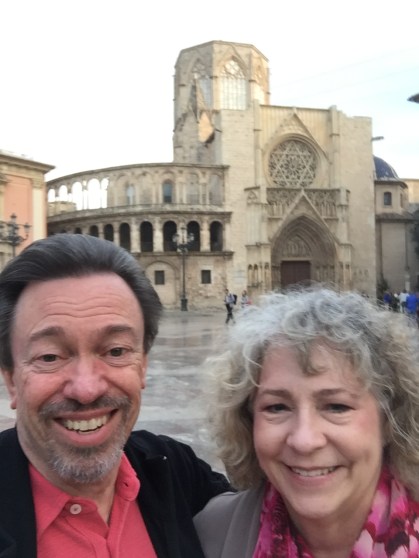
The next day, we spent some time in the Cathedral of Saint Mary, built between the 13th and 15th centuries, with additional work done over the centuries since. img_1223When we arrived in the plaza to meet our tour, we thought the building was a synagogue because the stained glass window includes the Star of David, as you can see in the photo (right). On the tour, though, we learned it was designed as a tribute to Jesus having been Jewish.

There are a number of chapels that contain precious works of art, including two Goya paintings. In one chapel, the left arm of St. Vincent the Martyr — patron saint of Valencia — is on display. And in the most important chapel, we saw the Holy Grail. Yes, THE Holy Grail, the cup Christ used at the Last Supper. Always skeptical, I did some research later. One brochure says this cathedral’s claim is actually quite strong. It seems other potential Christ cups have been debunked, but they claim the jury is still out on this one. Anything’s possible, I suppose.

Heading out of town, we were really impressed with Estacio del Nord, the train station that handles most regional traffic. The other station is for the high-speed AVE trains to Madrid. Nord is impressive, as you can see. Built in 1917, the tile work is incredible, inside and outside.img_1209

This weekend we plan to visit two smaller towns just up the coast from Alicante: Altea, which we once considered for a base, and Vila Joiosa which we’ve only learned about since being here. More on that later.


Finally, it seems that everywhere we go, we run into a wedding. Remember I told you about the wedding at Edinburgh Castle that stumbled upon us back at the beginning of the journey? And when we were in Greece a year ago with Educational Opportunities, I took some shots of a photographer shooting a wedding on the island of Santorini. Well, we were just about to leave the plaza outside the rear of the cathedral in Valencia when I turned and saw this couple. Weddings are everywhere, it seems. We hope they will be very happy together.img_1218


Church came to us this week. Complete with a brass band!

One reason for traveling to foreign lands is to experience other cultures. To see how other people live. Those of us afflicted with the travel bug are usually curious about how people live in other parts of the world. Here in Spain, daily life is — for the most part — similar to daily life back in Illinois. But there are some striking differences. More than just the siesta.

We haven’t been to church in a few weeks (I know, seems like a non sequitur but stick with me here), so this week, church came to us.

On Saturday night, about 8 p.m., Leslie and I were relaxing after a busy day; just reading our books and thinking about a nice salad for dinner. Then we heard music coming from somewhere — sounded almost like a drum and bugle corps, but playing in a minor key. The living room window overlooks a short street that leads to a small plaza, and we can’t see much from that window. As the music got louder, we put our shoes on and headed downstairs to see what was the matter (getting in the Christmas spirit there).

What we saw was this: img_1315From a distance, it looked like a parade float. But as it came closer we could tell it was a platform bearing a statue of Jesus carrying his cross to the crucifixion site. It was probably 20 to 30 feet high. There were flowers on the platform and candles on each corner. It was coming toward us, right down Calle Mayor, accompanied by an impressive procession of people with banners and long metal poles, each topped by a Jerusalem cross. And right behind the float was a brass band, playing what sounded like a dirge.

When the procession passed our apartment, we fell in with other people and followed. It ended at Basilica Santa Maria, the Roman Catholic church just a block or two from where we’re living. It’s the oldest church in Alicante, built between the 14th and 16th centuries. The people carried the platform by placing long poles on their shoulders. They were very close together and completely in step.  I counted 42 in front and 46 in back. With the massive church doors open, as you can see in the photo (left) img_1299they carried the platform right inside. This solemn procession was very impressive, and quite moving.

We watched the band milling around in the plaza outside the basilica and it seemed they were waiting for something. Sure enough, after about 15 or 20 minutes, those carrying the Christ statue brought it out of the church, turned it around with some deft maneuvers, and went right back up Calle Mayor to the Plaza Santa Faz.

Leslie and I felt like we had been to church — or rather, that church had come to us! I hope you’ll be able to see this 2-minute video and hear the band, but it was dark and all I had was my iPhone. I shot the video as they left the church, and at the end you can Basilica Santa Maria. Cue the bells!

Error
This video doesn’t exist

Now, I’m not Catholic so I can’t say this with total certainty, but I doubt you would see anything like this in a U.S. church. This is one of those cultural events that we can only appreciate through travel to other countries, and becoming immersed in other cultures. We’ve asked around but still don’t know exactly why this event was happening. We know it was something the Santa Maria congregation does regularly.

As the procession made its way away from the church, I noticed one priest on a cell phone. Maybe he was talking to the pope, who knows. And I noticed one little trumpet player in the band who was very determined. Looked like he was marching next to his father.img_1321

img_1319

Just one more note on the band — and how many churches in the U.S. have a brass band for cryin’ out loud — some of the instruments looked like bugles, but with valves. Now, I played trombone in the high school band, so I know my brass. But I have never seen anything like these valved bugles. Not valves like on a trumpet or cornet (I saw both of those instruments, too), but valves nonetheless. Maybe they’re historic. Who knows?

Are there downsides to other cultures? Of course. We’ve noticed that lots more people smoke in Europe. And they smoke in outdoor seating at restaurants, which is annoying to those of us accustomed to fully non-smoking restaurants.  It was true in the U.K. and also here in Spain. They don’t always clean up after their dogs, either.

But experiences like the Saturday night procession remind us why we travel, why we try to get a feel for what people do in other countries. When we learn about other cultures, we grow and expand our horizons. When we learn about other cultures, we often see more similarities than differences. When we learn about other cultures, we tend not to mistrust them or fear them.


Alicante is the best place in the world!

That’s actually the city’s official motto, as we learned today from guide Maria. She led our little group on a walking tour from the waterfront through the old town and up to Central Mercado, pointing out landmarks and giving us quite a history lesson.

Alicante has a troubled past. Lots of death and destruction in the War of the Spanish Succession and later the Spanish Civil War. This city was on the losing side in both conflicts. But since the mid-20th century — and especially since the 1980s —  things have gotten progressively better. Tourism has created many jobs, helping the population grow to more than 300,000. Now when you look northwest from the heights of the Castle Santa Barbara, you see a thriving city that feels good about itself. Hence, the motto.img_1278

While a few historic structures remain, most of the city’s buildings are 20th and 21st century. Alicante was bombed repeatedly by the fascists in the Spanish Civil War, and it became the last Republican city opposing Franco’s forces. Many of those who opposed Franco escaped Spain from the port of Alicante, which you can see in this photo, also taken from Castle Santa Barbara. The old city is prominent also. Just right of center, you may be able to see the blue domes of Co-cathedral of St.Nicolas. Stunning from the inside. It dates to the 1600s, but has been renovated several times, once following a fire.img_1286

In an earlier post, I wrote that I didn’t know the age of the apartment building we’re in. Update: Only about 60 years old, according to its owner, but the foundations are over 200 years old. That’s why the streets are so narrow. Some buildings in the area are older, such as the Alicante City Hall and Basilica Santa Maria, both of which survived bombardments from sea and air.

Central Mercado also survived an aerial bombardment on 25 May 1938. But 300 civilians were killed when bombs fell on the plaza just north of the market. A plaque in the plaza floor commemorates that tragic event.

On a cheerier note, Maria explained that tourism started taking off here when Scandinavians discovered Alicante’s beaches. At the time, though, highly restrictive dress codes for women prohibited bikinis. Even into the 1960s! So a delegation traveled to Madrid and petitioned the Franco government for relief. The Scandinavians won’t come  if the women can’t wear bikinis on the beach! And did we mention how much money tourists bring into the city? So the government eased off, and the tourists are still coming today. Here’s part of the main beach on Friday, Nov. 11, from Castle Santa Barbara. img_1289

So the people here think this is the best place in the world. Is it the best place for us to retire? Hey, this is our first stop. And we’ve only been here three weeks. Let us check out some other places.

But it’s definitely on the short list.